
TL;DR:
- Flip timeline financing is a short-term loan based on the property’s after repair value that funds both purchase and renovation. It typically runs 6 to 24 months, with disbursements tied to project milestones verified within 24 to 72 hours. Investors should build a time buffer and pre-qualify for longer-term options like DSCR refinancing to protect profits from delays and market shifts.
Flip timeline financing is a short-term, asset-based loan structured to fund both the purchase and renovation of an investment property, with loan terms calibrated to match the project’s planned resale schedule. The industry standard term for this product is a fix-and-flip loan, and understanding how it aligns with your project phases is the difference between a profitable exit and a costly overrun. These loans are underwritten on ARV, the property’s after repair value, rather than the borrower’s income or credit score. Loan terms typically run 6–24 months, matching the full arc of a flip from acquisition through resale. Holding costs, draw schedules, and loan-to-cost ratios all tie directly to how well your financing timeline matches your construction timeline.
What is flip timeline financing and how does it work?
Fix-and-flip loans combine purchase financing and renovation funding into a single loan package. That structure eliminates the need to close two separate loans and keeps capital moving through each project phase without interruption.
Underwriting focuses on the property’s ARV and the submitted renovation plan. Lenders approve these loans without requiring W-2s or tax returns, which enables faster closings and less borrower documentation than conventional mortgages. The property’s value after renovation, not your personal income, determines how much you can borrow.
Renovation funds are not released in a lump sum. Instead, lenders disburse them through a draw schedule tied to completed milestones. Draw funds are released within 24–72 hours after an inspector verifies each completed phase. That verification step protects both the lender and the investor by confirming work quality before money moves.
Loan-to-cost ratios follow a consistent structure across the market:
- Purchase financing: 80%–90% loan-to-cost at acquisition
- Renovation financing: Up to 100% of verified rehab costs
- Closing speed: Typically 7–14 days, far faster than conventional lending
- Loan term: 6–24 months, aligned to the projected flip schedule
- Underwriting basis: ARV and renovation plan, not borrower income
Pro Tip: Request a detailed draw schedule from your lender before closing. Knowing exactly which milestones trigger each disbursement lets you sequence contractor work to keep cash flowing without gaps.
What is the typical timeline for a flip project?
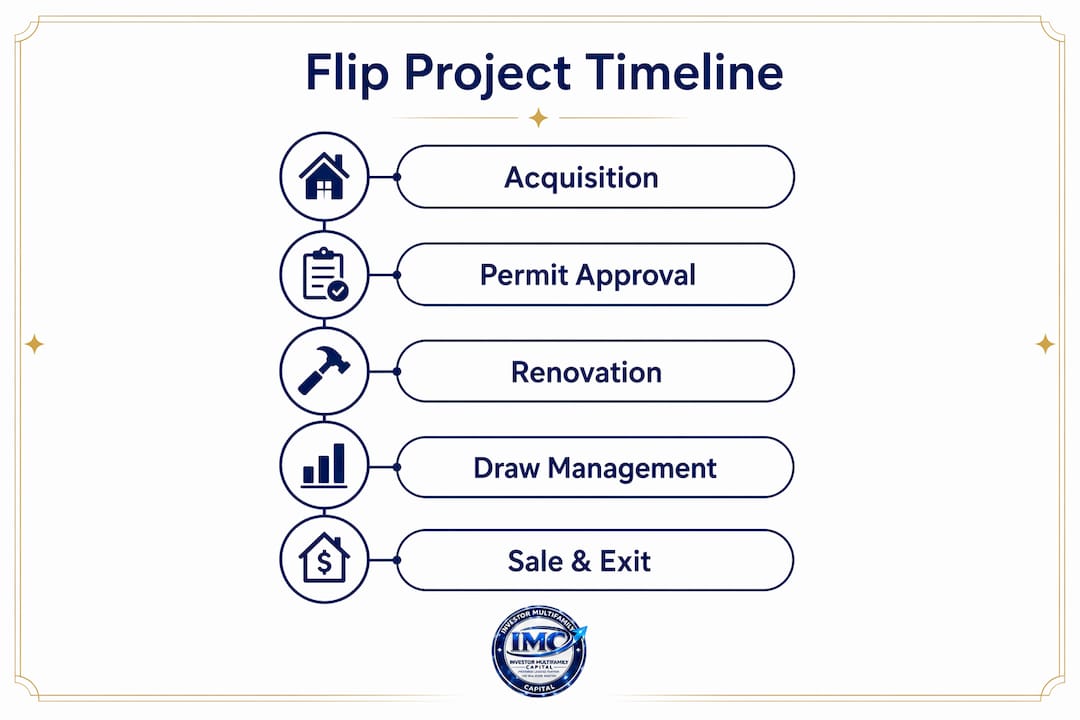
The average flip takes approximately 166 days, roughly 5.5 months, from acquisition to resale. Experienced investors running tight scopes on cosmetic rehabs can close in 8–12 weeks. That range directly determines the loan term you need.
A standard flip moves through six distinct phases, each with its own financing implications:
- Acquisition and pre-close: Secure financing, complete due diligence, and confirm the renovation scope before closing. Errors here cascade through every phase that follows.
- Scope finalization: Lock in contractor bids and a detailed line-item budget within the first week post-close. Scope creep is the primary driver of budget overruns.
- Demolition: Typically 1–2 weeks. This phase reveals hidden conditions, including mold, structural issues, or outdated electrical, that can reset the entire budget.
- Permits and inspections: The most unpredictable phase. Municipal processing times vary widely by jurisdiction and season.
- Interior finishes: Flooring, fixtures, paint, and staging. This phase is highly contractor-dependent and sensitive to supply chain delays.
- Listing and sale: Coordinate the listing date with your loan maturity. A property sitting on the market while interest accrues daily destroys margin.
Permit delays are the largest variable in any flip timeline. A projected 3-month rehab can extend to 6 months or longer when municipal processing stalls. That extension does not pause your loan. Interest, taxes, insurance, utilities, and HOA dues all continue to accrue. Holding costs accrue weekly and directly erode the profit margin you modeled at acquisition.
The practical implication is clear. Your financing term must include a buffer beyond your projected completion date. Underestimating timeline is the most common mistake investors make on their first several projects.
What risks and contingencies should investors consider?
ARV overestimation is the most dangerous underwriting risk in flip financing. Lenders stress-test ARV against comparable sales to avoid over-leveraging, but market conditions can shift between the time you close and the time you list. If your ARV estimate was aggressive and comparable sales soften, you may face a cash capital injection requirement or loan default.
Common risks that extend timelines and compress margins include:
- Permit delays: Pre-submit plans and identify permit triggers before acquisition to reduce municipal processing time
- Contractor issues: Missed deadlines, subcontractor conflicts, and labor shortages are the most frequent causes of schedule slippage
- Inspection failures: Failed rough-in inspections reset the draw schedule and delay disbursements
- Financing gaps: Slow draw documentation creates cash flow gaps that stall contractors and extend timelines
- Market softening: A declining resale market between acquisition and listing reduces net proceeds and may not cover loan payoff
Permitting is the largest uncontrollable variable in a flip schedule. Pre-submission of plans and identifying permit triggers before acquisition can mitigate costly delays. That due diligence step belongs in your pre-offer checklist, not your post-close to-do list.
The most effective contingency for a stalled flip is the bridge-to-DSCR refinancing strategy. Refinancing into a DSCR loan converts the property to a rental and replaces the short-term flip loan with longer-term financing based on the property’s rental income. This strategy preserves investment returns when resale is delayed or market conditions worsen. Investors who plan this exit before they need it execute it far more cleanly than those who discover it under pressure.
Pro Tip: Build a 15%–20% time buffer into your projected timeline before you select your loan term. If your rehab scope is 90 days, underwrite your financing for 120 days. The cost of a slightly longer term is always less than the cost of a maturity extension or forced sale.
How to optimize your flip financing strategy for better execution
Aligning your financing structure to your project schedule starts before you make an offer. Confirm that your expected rehab duration fits comfortably within the loan term you are targeting. A mismatch at this stage cannot be corrected cheaply later.

Post-close, verify your schedule accuracy immediately and adjust at every major milestone. Scope changes, permit timelines, and contractor availability all shift the critical path. Treating your flip timeline as a fixed document is a reliable way to run out of loan term before you run out of project.
Draw management is where many investors lose time they cannot recover. Timely draw documentation prevents financing delays that cascade into contractor slowdowns and project extensions. Submit draw requests the day a milestone is complete, not a week later. Delays in documentation translate directly into delays in disbursement, which translate into idle contractors and extended holding costs.
Integrate holding cost tracking into your project budget from day one. Track interest, taxes, insurance, and utilities on a weekly basis. That real-time view tells you exactly what each additional week of delay costs in dollar terms, which sharpens decision-making on scope changes and contractor disputes.
Prepare two exit strategies before you close. The primary exit is resale at or above your target ARV. The secondary exit is a DSCR loan refinance that converts the property to a rental if the resale market weakens or your timeline slips past your loan maturity. Investors who pre-qualify for DSCR financing before they need it avoid the worst outcomes in a softening market.
Key takeaways
Flip timeline financing succeeds when the loan term, draw schedule, and project phases align precisely, with ARV-based underwriting and a prepared contingency exit protecting returns at every stage.
| Point | Details |
|---|---|
| ARV drives underwriting | Fix-and-flip loans are sized on after repair value, not borrower income or credit score. |
| Draw schedules control cash flow | Renovation funds disburse in milestone-tied draws, verified by inspection within 24–72 hours. |
| Permit delays are the top risk | Municipal processing can double a projected rehab timeline and multiply holding costs. |
| Build in a time buffer | Select a loan term 15%–20% longer than your projected completion date to absorb delays. |
| DSCR refinancing is a real exit | Converting a stalled flip to a rental via DSCR financing preserves returns when resale conditions weaken. |
What I’ve learned about flip timeline financing after years in the field
The investors who consistently profit on flips are not the ones with the best deal flow. They are the ones who treat the financing timeline as a live operating document, not a closing formality.
Most novice investors set their timeline at acquisition and never revisit it until something goes wrong. By then, they are already two weeks past a draw milestone, their contractor has moved to another job, and their loan maturity is closer than their completion date. That sequence is avoidable. Reviewing the schedule weekly, tracking holding costs in real time, and adjusting contractor sequencing proactively are the habits that separate profitable operators from break-even ones.
The bridge-to-DSCR contingency is underused. Investors treat it as a failure scenario when it is actually a planned alternative exit. Pre-qualifying for DSCR financing before you need it costs nothing and gives you real negotiating leverage. If the resale market softens in month four of a six-month flip, you want that option ready to execute in days, not weeks.
The other thing most articles miss: ARV overestimation is not just a lender problem. It is an investor problem. If you push your ARV estimate to maximize your loan proceeds at closing, you are borrowing against a number the market may not validate. Conservative ARV underwriting at acquisition is not timid. It is the foundation of a deal that actually closes profitably.
— Joe
Investor MultiFamily Capital fix-and-flip financing for your next project
Investor MultiFamily Capital structures fix-and-flip loans around your project timeline, not a bank’s underwriting calendar. Loans close in 7–14 days, draw schedules align to your renovation milestones, and underwriting is based on ARV, not W-2s.

Investors in Massachusetts, Florida, New Hampshire, Rhode Island, Connecticut, and Maine can access both fix-and-flip financing and DSCR loan refinancing as a contingency exit when market conditions shift. Whether you are running your first flip or your fifteenth, Investor MultiFamily Capital underwrites to the deal, not the borrower’s tax return. Submit a Deal, Run Deal Analysis, or Apply Online to get your scenario reviewed.
Investor-only. Business-purpose investment property financing only. Not for owner-occupied or primary residence loans.
FAQ
What is a flip timeline financing loan?
Flip timeline financing, formally called a fix-and-flip loan, is a short-term asset-based loan that funds both the purchase and renovation of an investment property. Loan terms run 6–24 months and are underwritten on the property’s after repair value rather than borrower income.
How are renovation funds disbursed in a flip loan?
Renovation funds are released through a draw schedule tied to completed milestones. Lenders disburse funds within 24–72 hours after an inspector verifies each phase of completed work.
What loan-to-cost ratios do fix-and-flip lenders typically offer?
Most fix-and-flip lenders advance 80%–90% of the purchase price and up to 100% of verified renovation costs, with closings typically completed in 7–14 days.
What happens if my flip takes longer than the loan term?
If resale is delayed, investors can request a loan extension or refinance into a DSCR loan, converting the property to a rental and replacing the short-term flip loan with longer-term financing based on rental income.
What is the average timeline for a house flip?
The average house flip takes approximately 166 days, or about 5.5 months. Streamlined cosmetic rehabs can close in 8–12 weeks, while projects with permit delays can extend to six months or longer.