
TL;DR:
- Underwriting investment properties involves verifying cash flow, appraisals, and borrower documentation to confirm loan support. Proper calculation of DSCR and alignment of rent schedules are essential to ensure deal approval. Maintaining complete, accurate documents helps investors avoid delays and underwriting failures.
Underwriting an investment property purchase is the process of evaluating a property’s financial viability and risk to confirm it can support the proposed loan and deliver expected returns. Lenders and investors use this process to verify cash flow, assess borrower credit, and confirm that all documentation aligns before funds are committed. The real estate underwriting process centers on three pillars: the Debt Service Coverage Ratio (DSCR), a certified appraisal with a market rent schedule, and a complete borrower and entity documentation package. Getting these three elements right determines whether a deal closes or stalls.
What key financial metrics are required to underwrite investment properties?
DSCR is the primary metric lenders use to evaluate investment property financing. DSCR is calculated by dividing monthly gross rents by monthly PITIA (principal, interest, taxes, insurance, and association fees). A DSCR of 1.00x means rent exactly covers debt payments. A DSCR below 1.00x means the property does not fully cover its own debt service. Most lenders require a minimum DSCR of 1.00x to 1.25x depending on loan program and property type.

Cap rate measures a property’s unlevered yield. The formula is net operating income divided by purchase price. A higher cap rate signals stronger cash flow relative to price, but it can also reflect higher risk or a weaker market. Lenders use cap rate as a secondary check on whether the purchase price is supported by income.
Cash-on-cash return measures the annual pre-tax cash flow against the total cash invested. Investors use it to compare deals across different financing structures. Lenders care less about cash-on-cash return directly, but it signals whether an investor has stress-tested the deal at realistic rent and expense levels.
| Metric | Formula | Typical lender threshold |
|---|---|---|
| DSCR | Monthly gross rents / Monthly PITIA | 1.00x minimum; 1.25x preferred |
| Cap rate | NOI / Purchase price | Varies by market; 5%+ common |
| Cash-on-cash return | Annual pre-tax cash flow / Total cash invested | Investor benchmark; no fixed lender floor |
| LTV | Loan amount / Appraised value | 75%–80% maximum for most DSCR loans |
Pro Tip: Run your DSCR calculation using the lender’s exact PITIA formula before submitting. Many investors omit HOA fees or use estimated taxes, which materially lowers the actual DSCR and triggers conditions at underwriting.
How do appraisals and rent schedules affect the underwriting process?
The appraisal drives two critical outputs: the property’s market value and the market rent schedule. Lenders rely on appraiser-determined market rent rather than investor projections when calculating DSCR. This is a point many investors miss. The appraiser surveys comparable rentals in the area and produces a rent schedule, often using Form 1007 for single-family rentals or a comparable rent analysis for multifamily properties.
When the executed lease rent and the appraiser’s market rent differ, lenders typically use the lesser of the two figures. This conservative approach protects the lender from inflated income assumptions. If you are purchasing a tenant-occupied property with a below-market lease, your qualifying DSCR will reflect that lower rent, not the market rate.
Short-term rental properties follow a different income calculation. STR income is reduced by 20% before the DSCR calculation is applied. Lenders require 12 months of platform payout history from Airbnb, Vrbo, or similar platforms to document that income. Investors should plan their qualifying DSCR at 80% of gross STR revenue to avoid surprises at underwriting.
Key appraisal-related documentation to prepare:
- Executed purchase contract with the agreed purchase price
- Existing lease agreements for tenant-occupied properties
- 12-month STR payout history for short-term rental properties
- Any HOA documents that affect operating expenses
Pro Tip: Before making a purchase offer, review active comparable rental listings in the area. If appraiser market rent comes in below your underwriting assumption, your DSCR will drop and your loan terms may change.
What documentation and borrower criteria are required for an investment property loan?
The core DSCR loan application requires a loan application, credit authorization, executed purchase contract, property address and APN, existing lease if the property is tenant-occupied, and LLC entity documents if closing in an entity. No personal income documents are required for DSCR loans. This is a fundamental difference from conventional financing and a major reason investors prefer DSCR structures for scaling a portfolio.
Required documents at submission:
- Completed loan application and signed credit authorization
- Executed purchase contract
- Property address and assessor parcel number (APN)
- Current lease agreement (if tenant-occupied)
- LLC operating agreement, articles of organization, and EIN letter (if applicable)
- 12-month STR payout statements (for short-term rental properties)
- Proof of liquid reserves in verified accounts
Credit evaluation uses a tri-merge credit pull that draws reports from all three major bureaus. The middle FICO score determines the borrower’s credit tier and directly affects loan structure, pricing, and maximum LTV. This credit pull is a hard inquiry and will affect the FICO score. Investors should avoid opening new credit lines or carrying high balances in the 90 days before application.
Reserve requirements scale with loan size. Standard deals require two months of PITIA in liquid reserves. Loans above $1,500,000 require six months. Loans above $2,500,000 require 12 months of reserves. Reserves must be in verified, liquid accounts and cannot include retirement funds or equity lines unless the lender specifically allows them.
| Loan size | Reserve requirement |
|---|---|
| Standard | 2 months PITIA |
| Above $1,500,000 | 6 months PITIA |
| Above $2,500,000 | 12 months PITIA |
Step-by-step process for underwriting an investment property purchase
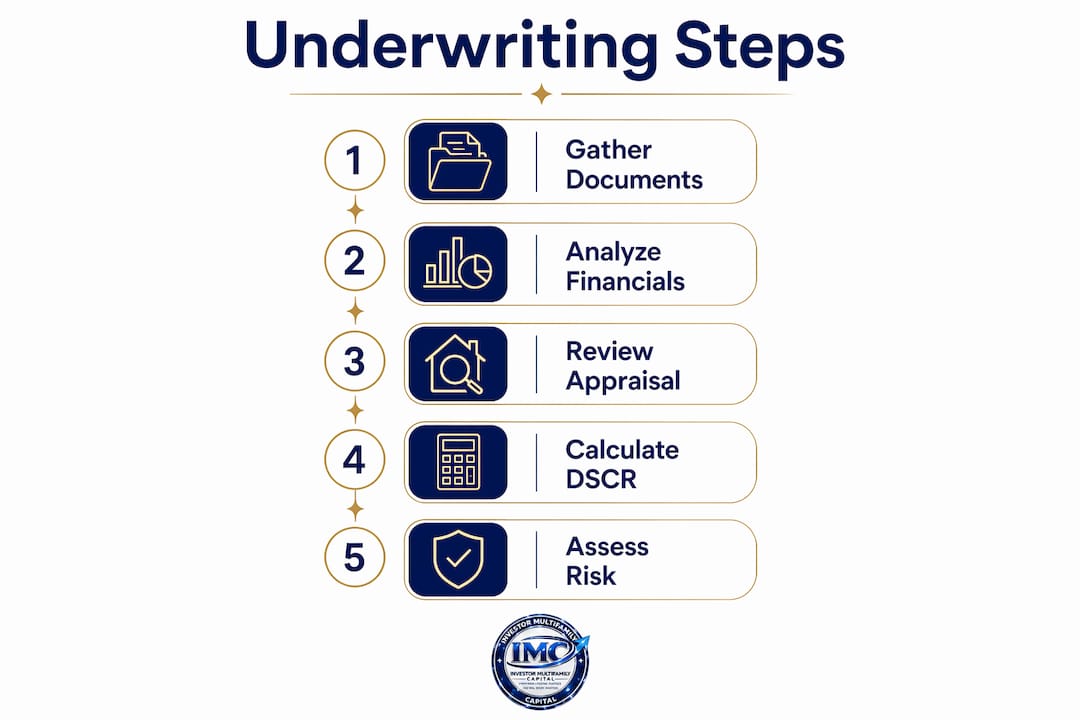
Underwriting creates a forward-looking financial model using verified documents to assess both property and financing risk. The process is document-heavy and assumption-driven. Informal estimates do not satisfy lender requirements. The steps below reflect how a DSCR-based investment property loan moves from application to approval.
- Gather and verify all documents. Collect the purchase contract, lease agreements, entity documents, and reserve statements before ordering anything else. Gaps at this stage cause delays later.
- Order the appraisal. The lender will order a certified appraisal that includes a market rent schedule. Do not use your own rent projections in the DSCR model until the appraisal is complete.
- Calculate DSCR using the lender’s formula. Use the appraiser’s market rent (or the lesser of lease rent and market rent) divided by the full PITIA, including taxes, insurance, and HOA fees.
- Assess the borrower credit profile. The lender pulls a tri-merge report. The middle FICO score sets the credit tier. Confirm the score is consistent with the loan program requirements before submission.
- Confirm reserve requirements. Match liquid reserve balances against the loan size thresholds. Document the source of funds with two months of bank statements.
- Prepare and submit the full underwriting package. Compile all documents into a single organized submission. Inconsistencies between the lease, rent roll, appraisal, and DSCR worksheet are the most common cause of conditions and declines.
Pro Tip: Build a deal checklist template you reuse for every acquisition. Consistent document organization signals professionalism to lenders and reduces back-and-forth during underwriting.
Common underwriting challenges and how to avoid them
PITIA calculation errors are the most frequent cause of DSCR shortfalls. Many investors calculate DSCR using only principal and interest, then discover at underwriting that taxes, insurance, and HOA fees push the PITIA higher and the DSCR below the lender’s minimum. The fix is simple: pull the actual tax bill, get an insurance quote, and confirm HOA fees before running your numbers.
Document misalignment is the second major failure point. Misalignments between the lease, rent roll, appraisal, and DSCR worksheet frequently cause underwriting failures. A lease showing $2,200 per month, a rent roll showing $2,000, and an appraisal market rent of $1,950 will trigger conditions and slow the process. Every income figure across every document must reconcile.
Common documentation gaps that cause delays:
- Missing LLC operating agreement or articles of organization
- No EIN letter when closing in an entity
- Expired or unsigned insurance binder
- STR payout history covering fewer than 12 months
- Reserve accounts that cannot be verified or are in non-liquid form
Timing credit pulls poorly is a less obvious but costly mistake. A hard inquiry from a new credit card or auto loan in the weeks before application can drop the middle FICO score enough to shift the borrower into a lower credit tier. That shift affects pricing, LTV, and in some cases, loan eligibility.
Cross-check every financial input before submission. Confirm that the rent figure in your DSCR model matches the appraisal, the lease, and the rent roll. One number out of alignment can trigger a full re-underwrite.
Loan pricing and approval depend on the combined effect of LTV, credit score, DSCR, property type, and geography. Investors who understand how these inputs interact can structure deals to hit better pricing tiers rather than accepting the first quote.
Key takeaways
Successful underwriting of an investment property purchase requires document alignment, accurate DSCR calculation using appraiser-determined rents, and a complete borrower package that meets lender credit and reserve thresholds.
| Point | Details |
|---|---|
| DSCR drives approval | Calculate DSCR using full PITIA and appraiser market rent, not investor projections. |
| Appraisal sets income | Lenders use the lesser of lease rent or appraiser market rent for DSCR calculations. |
| STR income is discounted | Short-term rental income is reduced by 20% before DSCR is calculated; document 12 months of platform payouts. |
| Reserves scale with loan size | Standard deals need 2 months PITIA; loans above $2,500,000 require 12 months in liquid accounts. |
| Document alignment is critical | Mismatches between leases, rent rolls, and appraisals are the leading cause of underwriting failures. |
What I’ve learned from underwriting deals that almost didn’t close
The investors who move through underwriting fastest are not the ones with the best spreadsheets. They are the ones with the cleanest document packages. I have seen deals with strong DSCR numbers stall for two weeks because the LLC operating agreement was unsigned or the insurance binder listed the wrong entity name. Those are fixable problems, but they cost time and sometimes cost the deal.
The second thing I have learned is that most PITIA surprises are avoidable. Investors who pull the actual tax bill and get a real insurance quote before running their numbers almost never get a DSCR shock at underwriting. The ones who estimate taxes at 1% of purchase price and assume low insurance costs are the ones calling their lender with questions after the appraisal comes back.
Understanding how lender credit tiers work also changes how you approach a deal. A borrower at a 720 FICO and a borrower at a 740 FICO may be in different pricing tiers with meaningfully different rates and LTV limits. Knowing that before you apply gives you time to address any credit issues rather than discovering them mid-process.
The trend in 2026 is toward tighter document standards, not looser ones. Lenders are requiring more reconciliation between income sources, and any gap between what the lease says and what the appraisal says gets scrutinized. Investors who build a repeatable underwriting workflow, with a consistent checklist and a habit of cross-checking every number, will close more deals with fewer conditions.
— Joe
Investor MultiFamily Capital: DSCR financing built for investors
Investor MultiFamily Capital specializes in business-purpose financing for real estate investors across New England and Florida. The DSCR loan program is built around property cash flow, not personal income, which means qualification is based on the numbers the underwriting process produces.
Investor MultiFamily Capital offers DSCR loan programs for single-family rentals, multifamily properties, and short-term rentals across Massachusetts, New Hampshire, Rhode Island, Connecticut, Maine, and Florida. The underwriting process is direct, document-driven, and designed for investors who know their numbers. If you have a deal under contract and a clean package ready, the next step is straightforward. Submit a Deal or Apply Online to run your scenario with the Investor MultiFamily Capital team.
FAQ
What is property underwriting for an investment purchase?
Property underwriting is the process of evaluating a rental property’s financial performance and risk to determine whether it qualifies for a loan. Lenders assess DSCR, appraisal value, borrower credit, and documentation to make that determination.
How is DSCR calculated for an investment property loan?
DSCR is calculated by dividing monthly gross rents by monthly PITIA. A result of 1.00x means rent exactly covers debt service; most lenders require at least 1.00x to 1.25x.
Do DSCR loans require personal income verification?
No. DSCR loans qualify based on property cash flow, not personal income. No tax returns, W-2s, or pay stubs are required as part of the standard application.
What reserves are required to close a DSCR loan?
Standard DSCR loans require two months of PITIA in liquid reserves. Loans above $1,500,000 require six months, and loans above $2,500,000 require 12 months in verified liquid accounts.
What causes most investment property underwriting failures?
Document misalignment is the leading cause. Inconsistencies between the lease, rent roll, appraisal market rent, and DSCR worksheet trigger conditions or declines. Cross-checking every income figure before submission prevents most failures.
Investor-only. Business-purpose investment property financing only. Not for owner-occupied or primary residence loans.
Recommended
- Investment Property Loans Built to Close | Investor MultiFamily Capital
- Investment Property Loans Built to Close | Investor MultiFamily Capital
- Investment Property Refinance Checklist for Investors | Investor MultiFamily Capital
- First Investment Property Loan Massachusetts | New Investor Financing | IMC