TL;DR:
- Multifamily financing involves loans based primarily on rental income, not personal income, to purchase or refinance properties.
- Loan types and qualification standards vary depending on property size, with smaller properties qualifying for residential loans and larger ones requiring commercial financing.
- Understanding DSCR is essential, as it determines maximum loan size based on cash flow, influencing borrowing capacity and refinancing options.
Multifamily financing is defined as specialized loan products used to purchase or refinance residential properties with two or more units, where rental income serves as the primary underwriting metric. Unlike single-family investment loans, multifamily property financing treats the property’s cash flow as the core qualifier, not the borrower’s personal income. The loan structure, lender type, and qualification standards shift significantly depending on whether the property has two to four units or five or more. Understanding these distinctions is the first step toward selecting the right financing for any acquisition or refinance scenario.
What is multifamily financing and how does it differ by property size?
The property unit count is the single most important variable in multifamily financing. It determines which lenders will consider the deal, which loan programs apply, and how underwriting is conducted.

Small multifamily properties, defined as two to four units, often qualify for residential mortgage products. This includes some agency loan programs and certain portfolio lenders who treat these assets similarly to single-family rentals. The underwriting process for these properties evaluates rental income alongside standard residential criteria.
Properties with five or more units cross into commercial territory. At this threshold, commercial multifamily loans through banks, agencies like Fannie Mae and Freddie Mac, or private lenders become the standard financing vehicle. Underwriting shifts almost entirely to property-level cash flow analysis, and personal income documentation plays a reduced role.
Investor qualification standards also diverge at this line. Commercial lenders typically require documented experience managing similar assets, financial statements for the property, and third-party reports that are not required for smaller residential deals. The cost and timeline of closing a five-plus unit deal is materially higher than closing a duplex or triplex.
- 2 to 4 units: Eligible for residential loan programs, lower documentation burden, shorter close timelines
- 5 to 9 units: Small commercial multifamily, typically financed through community banks or private lenders
- 10 to 50 units: Mid-market commercial multifamily, agency or bridge financing common
- 50+ units: Institutional commercial multifamily, Fannie Mae, Freddie Mac, and life company loans dominate
Pro Tip: If you are acquiring a five-unit property for the first time, expect lenders to scrutinize your management experience. Partnering with an experienced property manager before applying can materially improve your approval odds.
How DSCR controls loan sizing in multifamily underwriting
The debt service coverage ratio (DSCR) is the most consequential number in multifamily loan underwriting. DSCR is calculated as net operating income (NOI) divided by annual debt service. A property generating $120,000 in NOI with $96,000 in annual debt payments carries a DSCR of 1.25.
Most permanent multifamily lenders set a minimum DSCR of 1.20 to 1.25. This means the property must generate at least 20 to 25 cents of income for every dollar of debt payment. When a property’s NOI cannot support the requested loan amount at that ratio, the lender reduces the loan size until the math works. Property value becomes secondary to cash flow in this calculation.
DSCR does not disappear after closing. Many commercial multifamily loans include DSCR as a loan covenant, meaning the borrower must maintain the minimum ratio throughout the loan term. Falling below the covenant threshold can trigger cash management provisions or technical default, even if payments are current.
HUD’s updated FHA multifamily underwriting framework illustrates how loan sizing is constrained by the lesser of four tests: the requested mortgage amount, the statutory limit, debt service support, and loan ratio support. Recent HUD revisions increased LTV and LTC limits while lowering DSCR thresholds for affordable housing loans, making more capital available to qualifying projects.
| Metric | Typical Range | What It Controls |
|---|---|---|
| DSCR (permanent loan) | 1.20 to 1.25 minimum | Maximum loan amount based on cash flow |
| LTV (stabilized property) | 65% to 80% | Maximum loan as a percentage of appraised value |
| LTV (bridge loan) | 70% to 85% of cost | Acquisition and renovation budget coverage |
| Amortization | 25 to 30 years | Monthly payment and DSCR calculation base |
Pro Tip: Run your DSCR calculation before you submit a deal to any lender. Use actual market rents and realistic vacancy assumptions, not pro forma projections. Lenders will stress-test your numbers, and a deal that pencils at 1.30x on paper often comes in at 1.15x after underwriting adjustments.
Multifamily loan types comparison: agency, bridge, and DSCR loans
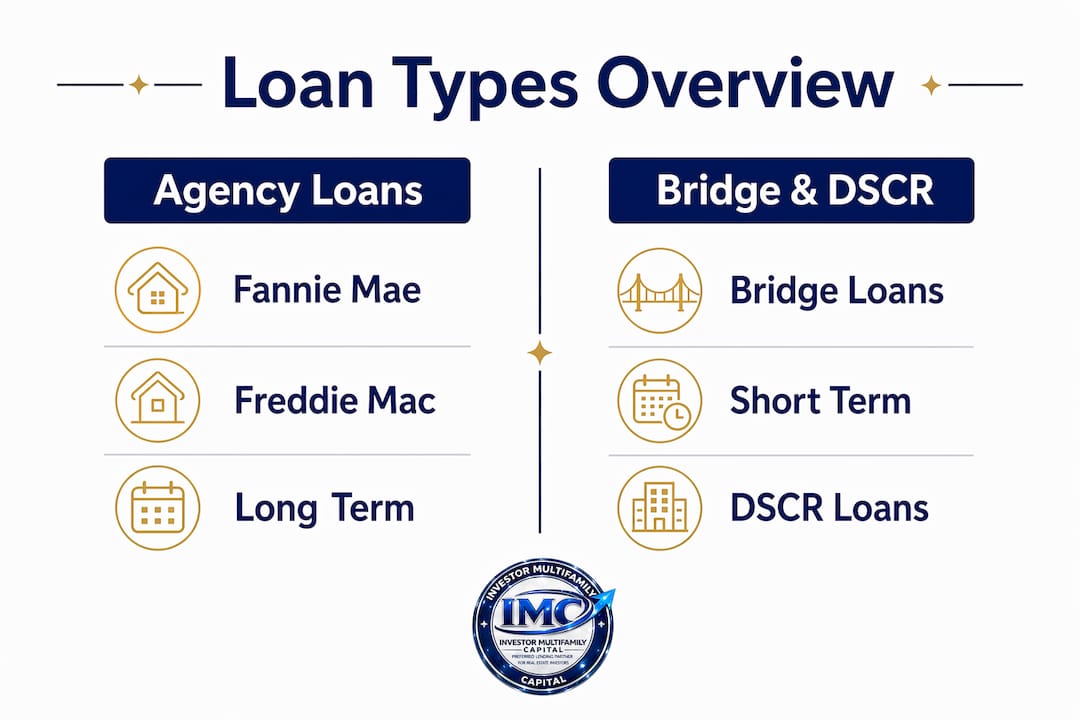
Three loan categories cover the majority of multifamily financing transactions. Each serves a different stage of the investment cycle and carries distinct terms, costs, and qualification requirements.
| Loan Type | Term | Best Use Case | Recourse | Key Requirement |
|---|---|---|---|---|
| Agency (Fannie Mae/Freddie Mac) | 5 to 30 years | Stabilized 5+ unit properties | Non-recourse | Experience, third-party reports |
| Bridge | 12 to 36 months | Acquisition, renovation, lease-up | Recourse | Exit strategy, property upside |
| DSCR | 5 to 30 years | Cash-flowing 2 to 10 unit properties | Varies | Property cash flow, no income docs |
Agency loans from Fannie Mae and Freddie Mac are the benchmark for stabilized commercial multifamily. These non-recourse loans protect the borrower’s personal assets in most default scenarios and include prepayment protections such as yield maintenance or step-down schedules. The tradeoff is a demanding qualification process. Fannie Mae requires extensive third-party reports upfront, including environmental Phase I assessments, physical condition assessments, and full appraisals. Lenders also verify borrower experience with comparable assets before approving agency financing.
Bridge loans are short-term financing with terms typically ranging from 12 to 36 months. They are the standard tool for value-add acquisitions where the property is not yet stabilized. An investor buying a 12-unit building with 40% vacancy uses a bridge loan to fund the acquisition and renovation, then refinances to permanent debt once occupancy and income stabilize. Interest rates are higher than permanent loans, and most bridge products are recourse. The exit strategy is the most critical underwriting factor for any bridge lender.
DSCR loans are purpose-built for real estate investors who want financing based on property cash flow rather than personal income documentation. These products work well for smaller multifamily properties, particularly in the two to ten unit range. Learn how DSCR multifamily loans are structured for investor properties to understand how lenders size these deals.
How multifamily financing works in practice
Walking through a real underwriting scenario clarifies how these concepts connect. Consider a 10-unit apartment building in Providence, Rhode Island, with a purchase price of $1,200,000. Gross rents are $18,000 per month. After applying a 7% vacancy factor and $4,500 in monthly operating expenses, the NOI comes to approximately $156,000 annually.
- Calculate DSCR: At a 1.25x minimum, the maximum annual debt service the property can support is $124,800 ($156,000 divided by 1.25).
- Size the loan: At a 30-year amortization and a 7% interest rate, $124,800 in annual payments supports a loan of approximately $1,040,000.
- Apply LTV check: At 75% LTV on a $1,200,000 purchase, the maximum loan is $900,000. LTV is the binding constraint in this scenario.
- Determine equity required: The investor needs $300,000 in equity plus closing costs, third-party report fees, and reserves.
Agency loans for properties like this require upfront investment in third-party reports before a commitment is issued. Environmental assessments and physical condition reports can cost $5,000 to $15,000 and are non-refundable if the deal does not close. Budget for these costs before entering the agency loan process.
Prepayment penalties are another common pitfall. Yield maintenance provisions on agency loans can make early payoff extremely expensive. An investor who plans to sell or refinance within five years should evaluate bridge or DSCR products with more flexible prepayment terms before committing to agency financing.
Investors new to multifamily frequently underestimate the experience requirements embedded in commercial lender underwriting. Lenders verify track records managing similar assets. If your portfolio does not include comparable properties, partnering with an experienced co-sponsor or property management firm can satisfy this requirement and open access to better loan terms.
Pro Tip: When refinancing a value-add property, time your loan application after at least 90 days of stabilized occupancy. Most lenders require a trailing three-month rent roll at or above 90% occupancy before issuing a permanent loan commitment.
Key takeaways
Multifamily financing requires matching the right loan product to the property’s current cash flow, unit count, and investment stage.
| Point | Details |
|---|---|
| Unit count determines loan type | Properties with 2 to 4 units access residential programs; 5+ units require commercial financing. |
| DSCR drives loan sizing | Lenders size loans based on cash flow first, property value second, using a minimum 1.20 to 1.25x ratio. |
| Bridge loans serve value-add deals | Short-term bridge financing covers acquisition and renovation before refinancing to permanent debt. |
| Agency loans carry upfront costs | Fannie Mae and Freddie Mac loans require third-party reports costing thousands before commitment. |
| Experience matters at scale | Commercial lenders verify asset management track records; co-sponsors can fill experience gaps. |
What I’ve learned about picking the right multifamily loan
After working through hundreds of multifamily financing scenarios across New England and Florida, the most consistent mistake I see is investors selecting a loan product based on rate rather than fit. A lower-rate agency loan sounds better than a DSCR product until you factor in the three-month timeline, the $12,000 in upfront reports, and the yield maintenance penalty that makes a refinance in year four prohibitively expensive.
The right loan is the one that matches your exit strategy. If you are buying a stabilized 20-unit building and plan to hold it for 10 years, agency financing makes sense. If you are buying a 12-unit with deferred maintenance and 60% occupancy, a bridge loan is the only product that fits the deal. Trying to force a value-add acquisition into permanent financing is one of the most common ways investors lose time and money.
I also see investors underestimate how much DSCR analysis matters before they make an offer. Running the numbers after you are under contract is too late. If the property’s NOI cannot support the loan you need at a 1.25x DSCR, you either need to renegotiate the price, increase the equity, or walk away. Knowing this before you submit an offer gives you real negotiating leverage.
For investors who want to learn how to qualify for a DSCR loan before approaching a lender, understanding the underwriting math in advance is the single best preparation you can do.
— Joe
Multifamily financing solutions from Investor MultiFamily Capital
Investor MultiFamily Capital structures business-purpose financing for real estate investors across New England and Florida, with loan products designed specifically for multifamily acquisitions and refinances.
Whether you need a DSCR loan for a stabilized cash-flowing property or a bridge loan to fund a value-add acquisition, Investor MultiFamily Capital underwrites based on property cash flow, not personal income. Serving investors in MA, NH, RI, CT, ME, and FL, the team moves fast on deals that make sense. Review your scenario today at Investor MultiFamily Capital multifamily financing or submit a deal directly to get a same-day response.
FAQ
What is multifamily financing in simple terms?
Multifamily financing refers to loan products used to purchase or refinance properties with two or more residential units, where the property’s rental income is the primary underwriting factor rather than the borrower’s personal income.
How does DSCR affect my multifamily loan amount?
DSCR controls the maximum loan size by requiring that NOI divided by annual debt service meets a minimum ratio, typically 1.20 to 1.25x. If the property’s cash flow cannot support the requested loan at that ratio, the lender reduces the loan amount until it does.
What is the difference between a bridge loan and a permanent multifamily loan?
Bridge loans are short-term products, typically 12 to 36 months, used for acquisitions and renovations before a property is stabilized. Permanent loans, including agency and DSCR products, are long-term financing used once the property reaches stable occupancy and income.
Do I need experience to qualify for a commercial multifamily loan?
Yes. Commercial multifamily lenders, including Fannie Mae-approved lenders, verify borrower experience managing comparable assets. Investors without a qualifying track record can partner with an experienced co-sponsor or property manager to meet this requirement.
What upfront costs should I expect with agency multifamily financing?
Agency loans through Fannie Mae and Freddie Mac require third-party reports including environmental Phase I assessments, physical condition assessments, and appraisals before a loan commitment is issued. These reports typically cost between $5,000 and $15,000 and are non-refundable.
Investor-only. Business-purpose investment property financing only. Not for owner-occupied or primary residence loans.
Recommended
- Investor Financing Insights | Investor MultiFamily Capital Blog
- Multifamily Financing | Investor MultiFamily Capital
- Multifamily Permanent Financing: Long-Term Loans for Investment Property Stability | Investor MultiFamily Capital
- Why Leverage Matters for Multifamily Investors | Investor MultiFamily Capital