
TL;DR:
- A real estate portfolio is a deliberate collection of assets designed to generate income, equity, and manage risk through diversification. Effective management involves balancing active oversight, micro-market analysis, and appropriate financing structures like DSCR loans to scale holdings successfully. Building a durable portfolio requires clear strategies, disciplined financing, and defining precise investment criteria before acquiring assets.
A real estate portfolio is a structured collection of property assets and real estate investment instruments assembled to generate income, build equity, and manage risk across multiple holdings. Unlike owning a single rental property, a portfolio represents a deliberate real estate investment strategy with defined financial goals: cash flow, appreciation, equity paydown, tax advantages, and inflation protection. Returns flow through five channels, and leverage amplifies each one by letting you control far more asset value than your invested capital alone. Whether you hold two single-family rentals in Massachusetts or a mix of multifamily units, REITs, and commercial properties across New England and Florida, the portfolio framework is what transforms individual deals into a coordinated wealth-building system.
What is a real estate portfolio and what assets belong in one?
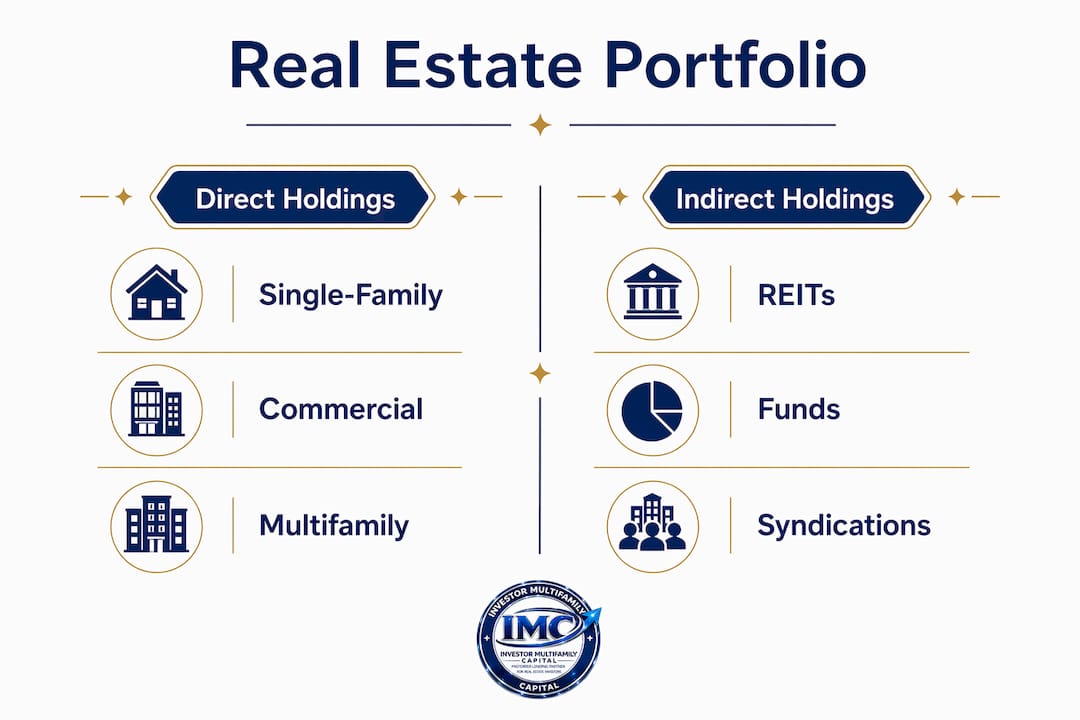
A real estate portfolio is a deliberate collection of assets aimed at income generation and capital appreciation, structured with a defined risk profile. The industry term is “investment property portfolio,” and it spans both direct and indirect ownership. Direct assets include single-family rentals, small multifamily properties (two to four units), large multifamily apartment buildings, commercial properties, and industrial assets. Indirect assets include Real Estate Investment Trusts (REITs) and real estate funds, which offer exposure without property management responsibilities.

The key distinction between direct and indirect holdings is control versus liquidity. Direct ownership gives you full control over financing, improvements, and tenant selection, but capital is illiquid. REITs trade on public exchanges like the NYSE, making them easy to buy or sell, but you surrender operational control entirely. Most active investors combine both to balance cash flow from direct holdings with liquidity from indirect positions.
| Investment Type | Control | Liquidity | Risk Level |
|---|---|---|---|
| Single-family rental | High | Low | Moderate |
| Multifamily (2-4 units) | High | Low | Moderate |
| Commercial property | High | Low | Higher |
| REITs | None | High | Lower to moderate |
| Real estate funds | Low | Moderate | Varies |
Pro Tip: Define your investment “buy box” before acquiring any asset. A buy box specifies neighborhood, price range, property type, minimum cash-on-cash return, and vacancy tolerance. Without it, every deal looks like an opportunity and emotional purchases replace disciplined acquisitions.
What types of investments typically make up a real estate portfolio?
Single-family homes are the most common entry point, but they scale slowly. Each acquisition requires a separate transaction, separate financing, and separate management setup. Small multifamily properties (duplexes, triplexes, and four-unit buildings) solve this problem. Fewer transactions are needed to add meaningful unit count, which accelerates portfolio growth without proportionally increasing overhead.
Commercial and industrial properties offer longer lease terms and triple-net structures that shift operating costs to tenants, but they require larger capital reserves and more sophisticated underwriting. Mixed-use properties, which combine retail or office space with residential units, add complexity but can produce stronger blended yields in urban markets like Boston or Providence.
REITs serve a specific function in a portfolio: they provide sector exposure (industrial, healthcare, self-storage) without the operational burden. An investor holding direct multifamily assets in New Hampshire might add an industrial REIT to gain exposure to logistics real estate without acquiring a warehouse. This is portfolio construction thinking, not just deal hunting.
How do investors manage and diversify a real estate portfolio effectively?
Effective portfolio management requires risk balancing through diversification across asset types and geographic locations. Concentration in a single asset class or single market is the most common structural risk in investor portfolios. An investor holding five single-family rentals in one zip code faces correlated vacancy risk: if that neighborhood softens, all five properties underperform simultaneously.
Geographic diversification does not mean buying randomly across states. It means understanding micro-market fundamentals at the street level. Micro-market analysis focuses on employment density, school quality, walkability scores, and permit activity for specific blocks and corridors, not broad metro-level statistics. An investor in southern New Hampshire who tracks Manchester’s Ward 9 employment trends separately from Ward 3 is practicing micro-market analysis. This approach produces better acquisition decisions and stronger portfolio resilience.
Managing a real estate portfolio also means balancing active and passive responsibilities:
- Active management tasks: Tenant screening, lease renewals, maintenance coordination, capital expenditure planning, and property-level financial tracking.
- Passive oversight tasks: Quarterly financial reviews, market monitoring, refinancing decisions, and portfolio-level performance analysis.
- Third-party support: Property management companies handle day-to-day operations for a fee (typically 8 to 12 percent of gross rents), freeing investors to focus on acquisition and capital allocation.
- Financial reviews: Quarterly financial assessments and capital expenditure planning are owner responsibilities regardless of whether a property manager is in place.
Pro Tip: Even a fully managed portfolio is not passive at the ownership level. Schedule quarterly reviews of each property’s net operating income, occupancy rate, and deferred maintenance backlog. Catching a cash flow problem in Q2 costs far less than discovering it during a refinance in Q4.
What are the practical steps and financing options to build a real estate portfolio?
Building a real estate portfolio follows a logical progression from low-capital entry points to scaled financing structures. The sequence matters because each stage unlocks the next.
- Define your investment criteria. Set your buy box before looking at deals. Specify target markets, property types, minimum cash-on-cash return (many investors use 8 percent as a floor), and maximum price point.
- Start with house hacking or small multifamily. FHA loans require 3.5% down for owner-occupied properties, and conventional loans go as low as 5 percent down, making small multifamily an accessible entry point for new investors willing to live in one unit.
- Build equity and cash flow in early assets. The first two or three properties generate the track record and equity base needed to access investor-grade financing.
- Transition to DSCR and bridge loans for scaling. Once you move beyond owner-occupied financing, DSCR and bridge loans become the primary tools. DSCR loans qualify based on property cash flow, not personal income, which removes the W-2 income ceiling that limits conventional borrowing. Bridge loans fund acquisitions and value-add projects while permanent financing is arranged.
- Use equity from existing assets to fund new acquisitions. Cash-out refinancing on appreciated properties recycles capital without requiring new outside equity. This is the BRRRR method (Buy, Rehab, Rent, Refinance, Repeat) applied at the portfolio level.
- Explore rental portfolio financing structures. Portfolio loans consolidate multiple properties under a single financing facility, simplifying management and often improving terms as the portfolio grows.
Understanding leverage’s role in multifamily investing is critical at every stage. Leverage amplifies returns on equity but also amplifies losses if cash flow turns negative, so each acquisition must underwrite conservatively.
What risks and challenges do real estate investors face in portfolio management?
Every real estate portfolio carries structural risks that require active monitoring. The table below summarizes the most common risk factors and the corresponding mitigation strategies.
| Risk Factor | Description | Mitigation Strategy |
|---|---|---|
| Market concentration | All assets in one market or asset class | Diversify across geographies and property types |
| Vacancy and cash flow gaps | Extended vacancies drain reserves | Maintain 3 to 6 months of operating reserves per property |
| Emotional acquisitions | Buying outside the buy box | Strict buy box criteria prevent impulsive purchases |
| Office and commercial volatility | Remote work has structurally reduced office demand | Limit commercial exposure; favor industrial and residential |
| Tax and regulatory changes | Rent control, depreciation rules, 1031 deadlines | Work with a CPA specializing in real estate investment |
| Leverage risk | High LTV increases sensitivity to value declines | Underwrite to conservative DSCR minimums (1.25x or higher) |
The office sector deserves specific attention in 2026. Remote and hybrid work has permanently reduced demand for traditional office space in many markets, and investors who concentrated portfolios in suburban office parks face significant impairment. Industrial, self-storage, and residential multifamily have absorbed capital fleeing office assets, which has compressed cap rates in those sectors. Knowing which asset types carry structural tailwinds versus headwinds is a core portfolio management skill.
How can technology and professional resources enhance portfolio management?
Technology has reduced the operational burden of managing a real estate portfolio without eliminating the need for owner-level judgment. The most useful tools fall into three categories:
- Portfolio management software: Platforms like Stessa and Buildium track income, expenses, and depreciation across multiple properties in real time. Stessa is free for basic use and integrates with bank accounts to automate transaction categorization.
- Deal sourcing and market intelligence: BiggerPockets Listings provides deal alerts filtered by market and property type. CoStar and LoopNet serve commercial investors with transaction comps and vacancy data at the submarket level.
- Professional property management: For investors with five or more units, third-party management typically pays for itself through reduced vacancy and better tenant retention. The 8 to 12 percent management fee is a deductible operating expense.
- Financial and tax advisors: A CPA with real estate investment experience manages depreciation schedules, cost segregation studies, and 1031 exchange timelines. These are not optional for a growing portfolio.
- Ongoing education: Podcasts like the BiggerPockets Real Estate Podcast and market reports from CBRE and Marcus and Millichap provide current data on cap rates, rent growth, and transaction volume by market.
Investment property loan options also function as a resource. Understanding which financing structure fits each acquisition type (DSCR for stabilized rentals, bridge for value-add, construction for ground-up) prevents costly refinancing later.
Key takeaways
A real estate portfolio generates durable returns only when built on defined investment criteria, diversified across asset types and markets, and financed with structures matched to each property’s cash flow profile.
| Point | Details |
|---|---|
| Definition matters | A portfolio is a structured collection of assets with defined income and risk goals, not just multiple properties. |
| Diversification is structural | Spread holdings across asset types and micro-markets to reduce correlated vacancy and value risk. |
| Financing drives scale | DSCR and bridge loans remove the W-2 income ceiling and enable faster portfolio expansion. |
| Buy box discipline | Define acquisition criteria before evaluating deals to prevent emotional purchases and portfolio drift. |
| Active oversight is required | Quarterly financial reviews and capital planning are owner responsibilities regardless of management structure. |
Why I think most investors build portfolios backwards
Most investors I talk to start with a deal and work backwards to a strategy. They find a property they like, run numbers that barely pencil, and then rationalize it as “portfolio building.” That is not a portfolio strategy. That is deal addiction with a spreadsheet attached.
The investors who build durable portfolios start with the end state. They define what a 10-property portfolio looks like in terms of cash flow, equity, and management load, then work backwards to identify which asset types and markets get them there most efficiently. That clarity changes every acquisition decision. A duplex in Manchester, NH that produces $400 per month in net cash flow looks different when you know your goal is $8,000 per month in total portfolio cash flow versus when you are just trying to “get started.”
Financing discipline is equally underrated. Investors who use DSCR loans early in their scaling phase preserve personal income capacity for other uses and avoid the conventional loan ceiling that stops most W-2 investors at four to ten properties. The multifamily financing structures available in 2026 are genuinely more flexible than they were five years ago, and investors who understand the product menu have a real structural advantage over those who default to conventional lending.
My honest advice: spend more time on your buy box than on your deal pipeline. A tight buy box makes the pipeline work for you instead of the other way around.
— Joe
How Investor MultiFamily Capital supports your portfolio growth
Building a real estate portfolio requires financing that moves at the speed of deals, not the speed of bank committees. Investor MultiFamily Capital provides business-purpose financing across DSCR loans, bridge, fix-and-flip, BRRRR, multifamily, construction, cash-out refinance, and deal rescue products for investors in Massachusetts, New Hampshire, Rhode Island, Connecticut, Maine, and Florida.

Qualification is based on property cash flow, not personal income. That means no W-2 requirements, no personal income documentation delays, and no artificial ceiling on how many properties you can finance. Whether you are stabilizing your second rental or scaling past ten units, Investor MultiFamily Capital structures financing around your portfolio goals. Learn how a DSCR loan can accelerate your next acquisition. Submit a Deal or Apply Online to review your scenario today.
FAQ
What is a real estate portfolio?
A real estate portfolio is a structured collection of property assets and real estate investment instruments, including direct ownership and indirect holdings like REITs, assembled to generate income, build equity, and manage risk across multiple positions.
How do I start building a real estate portfolio?
Start by defining a buy box with specific criteria for property type, market, price range, and minimum cash flow. Entry-level investors often begin with small multifamily properties using conventional financing before transitioning to DSCR loans for scaling.
What is a DSCR loan and why does it matter for portfolio building?
A DSCR loan qualifies based on the property’s debt service coverage ratio rather than the borrower’s personal income. This removes the income ceiling that limits conventional borrowing and allows investors to scale a portfolio beyond the four-to-ten property threshold common with traditional financing.
How many properties make a real estate portfolio?
There is no minimum number. Two properties with a defined investment strategy and financial goals constitute a portfolio. The distinction is intentionality: a portfolio is managed as a coordinated system, not as isolated individual assets.
What are the biggest risks in managing a real estate portfolio?
Market concentration, vacancy gaps, emotional acquisitions outside the buy box, and excessive leverage are the primary risks. Mitigation requires geographic and asset-type diversification, operating reserves, strict acquisition criteria, and conservative DSCR underwriting minimums of 1.25x or higher.
Investor-only. Business-purpose investment property financing only. Not for owner-occupied or primary residence loans.
Recommended
- Rental Portfolio Financing | Investor MultiFamily Capital
- Leverage Explained for Property Investing: 2026 Guide | Investor MultiFamily Capital
- Real Estate Leverage Explained for Investors in 2026 | Investor MultiFamily Capital
- Investment Property Loan Options for Real Estate Investors | Investor MultiFamily Capital