TL;DR:
- Short-term loans have repayment terms of 12 months or less for personal use and up to 24 months for business purposes.
- They offer quick funding but carry risks from extensions and misaligned project timelines.
A short-term loan is defined as a financing product with a repayment term of 12 months or less for personal loans, and up to 24 months for business-purpose loans. For real estate investors, understanding the short-term loan term explained in full means knowing not just the repayment window, but how lenders set terms, what fees compound over time, and how products like bridge loans and DSCR loans differ from consumer credit. This article breaks down every layer of short-term financing so you can match the right loan structure to your next deal.
How do short-term loans work?
Short-term loans repay in 3–12 months for personal borrowers, and 3–24 months for business-purpose loans. That compressed timeline changes everything about how lenders price and structure the product.
Repayment comes in two forms. Lump-sum repayment means you pay the full principal plus fees on a single due date, which is common with payday and merchant cash advance products. Installment repayment spreads principal and interest across equal monthly payments, which is the structure used by most commercial bridge and DSCR loans.
Lenders set terms based on several factors:
- Creditworthiness and income for consumer loans
- Property cash flow and DSCR for investment property loans
- Loan-to-value (LTV) ratio on the collateral
- Exit strategy (sale, refinance, or stabilization)
- Market conditions in the subject property’s region
APR varies widely across the short-term loan spectrum. Payday loan APRs exceed 300–600%, while the Federal Reserve has noted average personal loan APRs near 12% for 24-month installment products. Commercial bridge and hard money loans sit in a different category entirely, priced on deal risk and property metrics rather than personal credit scores.
Short-term loans also fund in 24–48 hours in many cases. That speed is a core feature, not a coincidence. Lenders accept more concentrated risk in exchange for a shorter exposure window.
Pro Tip: Always confirm whether your lender charges an origination fee, draw fee, or prepayment penalty before signing. These costs can shift the effective APR significantly on a 6-month loan.
Benefits and drawbacks of short-term loans vs. long-term loans
Short-term loans reduce cumulative interest costs compared to long-term loans, even though monthly payments are larger. The math is straightforward: fewer months of interest accrual means less total cost, provided you repay on schedule.
Short-term loans also reduce exposure to interest rate hikes and economic shifts. A 12-month bridge loan locks you into current market conditions for one year. A 30-year mortgage exposes you to decades of rate and policy changes. For investors who plan to sell or refinance within 12–18 months, that predictability has real value.
The drawback is cash flow pressure. Higher monthly installments can strain operating budgets if the investment does not generate income immediately. A fix-and-flip that runs three months over schedule can turn a manageable payment into a serious problem.
| Factor | Short-term loan | Long-term loan |
|---|---|---|
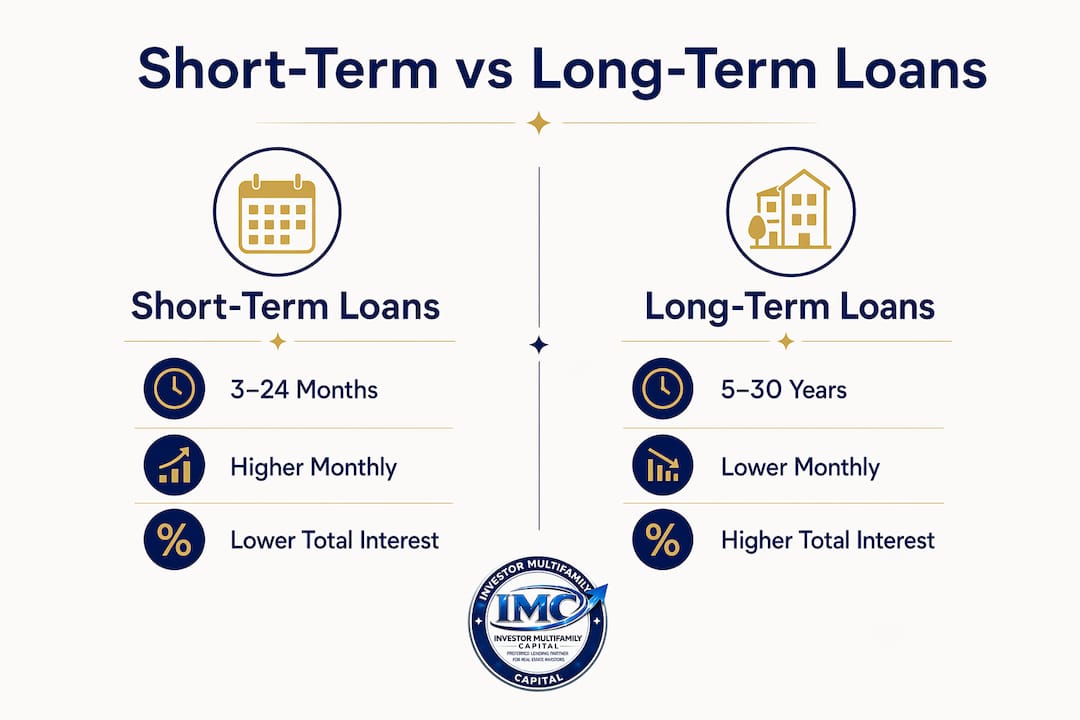
| Repayment window | 3–24 months | 5–30 years |
| Monthly payment size | Higher | Lower |
| Total interest paid | Lower | Higher |
| Rate volatility exposure | Minimal | Significant |
| Best use case | Flips, bridge, urgent capital | Stabilized rentals, hold strategies |
| Funding speed | 24–48 hours typical | Several weeks |
Pro Tip: Run a cash flow stress test before committing to a short-term loan. Model a scenario where your project runs 60 days over budget. If the monthly payment still clears your reserves, the loan term fits your deal.
Key short-term loan terminology every investor must know
Understanding short-term loan definitions goes beyond knowing the repayment window. The terms below directly affect total cost and borrower risk.
APR (Annual Percentage Rate): The annualized cost of borrowing, including interest and fees. On a 6-month loan, even a modest origination fee translates to a high APR because the cost is compressed into a short period.

Repayment term: The contractual period from funding to final payment. This is the number lenders advertise most prominently, but it does not capture extension fees or rollover costs.
Rollover or renewal: A mechanism that extends the loan term when the borrower cannot repay on the original due date. Extensions can double or triple total cost through compounding fees. Rollover cycles are the primary reason consumer short-term loans become long-term debt traps.
DSCR (Debt Service Coverage Ratio): The ratio of a property’s net operating income to its total debt service. A DSCR above 1.0 means the property generates enough income to cover its loan payments. DSCR loans qualify investors on property cash flow, not personal income, which allows scaling beyond personal debt-to-income limits.
LTV (Loan-to-Value): The loan amount divided by the property’s appraised value. Lower LTV means more equity and typically better loan terms.
Common pitfalls investors encounter with short-term financing:
- Underestimating origination fees on back-to-back bridge loans
- Confusing loan term with amortization period on interest-only products
- Assuming a short term means a simple underwrite. Commercial lenders still require full property analysis.
- Ignoring prepayment penalties on loans with minimum interest periods
- Treating a rollover as a routine option rather than a cost event
| Term | Definition | Investor impact |
|---|---|---|
| APR | Annualized total borrowing cost | Compares true cost across loan products |
| DSCR | NOI divided by debt service | Determines qualification on investment property |
| Rollover | Fee-based term extension | Can multiply total loan cost rapidly |
| LTV | Loan amount as percent of value | Affects rate, approval, and required equity |
| Interest-only period | Payments cover only interest, not principal | Lowers monthly payment but delays payoff |
How real estate investors use short-term loans strategically
Consumer short-term loans differ fundamentally from commercial bridge and hard money loans. The former are unsecured or minimally secured products for personal expenses. The latter are secured by real estate and structured around investment timelines and exit strategies.
Real estate investors apply short-term financing across several strategies:
- Fix-and-flip: A fix-and-flip loan funds acquisition and renovation, with repayment triggered by the property sale. The loan term aligns with the project timeline, typically 6–12 months.
- BRRRR (Buy, Rehab, Rent, Refinance, Repeat): The short-term bridge or hard money loan covers the acquisition and rehab phase. Once the property is stabilized and rented, the investor refinances into a DSCR loan. BRRRR financing depends entirely on the investor’s ability to execute the refinance before the bridge term expires.
- Bridge loans: A commercial bridge loan covers the gap between purchasing a property and securing permanent financing or completing a sale. Terms run 6–24 months and are secured by the subject property.
- STR/Airbnb: Short-term rental investors use bridge financing to acquire and prepare properties, then transition to DSCR loans once occupancy and revenue are established.
- Deal rescue: When a conventional lender pulls out late in a transaction, short-term commercial financing can close the gap and preserve the deal.
The critical variable in all of these scenarios is velocity of return. Financial experts recommend matching loan duration to the expected timeline for generating returns from the investment. A 6-month loan on a project with a 10-month renovation runway creates a mismatch that forces costly extensions or a rushed exit.
Short-term loans are best suited for urgent capital needs, quick-return investments, and bridge periods where the borrower has a clear and documented exit. Investors who treat short-term financing as a long-term solution consistently pay more than necessary.
DSCR loans occupy a specific position in this ecosystem. They are not always short-term products, but they frequently serve as the refinance exit for short-term bridge and hard money loans. Understanding how to qualify for a DSCR loan before you take the bridge loan is the move that separates experienced investors from those who get caught at maturity.
Key Takeaways
Short-term loans cost less in total interest than long-term loans, but only when the loan term aligns precisely with the investment’s cash flow timeline and exit strategy.
| Point | Details |
|---|---|
| Repayment windows | Personal loans run 3–12 months; business-purpose loans extend to 24 months. |
| Total interest advantage | Shorter terms reduce cumulative interest despite higher monthly payments. |
| Rollover risk | Extensions compound fees rapidly and can multiply total loan cost. |
| DSCR qualification | Investment property loans qualify on property cash flow, not personal income. |
| Term-to-exit alignment | Match loan duration to your project’s return timeline to avoid forced extensions. |
Why I think most investors misread short-term loan risk
The most common mistake I see is investors treating the loan term as the primary risk variable. They focus on “can I repay in 12 months?” and stop there. The real question is “what happens in month 13 if I cannot?”
Short-term loans are unforgiving at maturity. A long-term mortgage gives you years of runway if a deal underperforms. A 12-month bridge loan gives you a hard deadline. Lenders will extend, but extensions add compounding fees that erode your margin fast. I have seen investors lose their profit on a solid flip because they needed two 90-day extensions at 1% per month.
The second mistake is conflating speed with simplicity. Short-term commercial loans fund quickly, but the underwriting on a bridge or hard money product is not casual. Lenders are evaluating your exit strategy as carefully as your entry. If your refinance exit depends on a DSCR loan, you need to know your projected rent income and operating expenses before you take the bridge. Investors who skip this step often discover at month 10 that their DSCR does not qualify for the refinance they planned.
My practical advice: build your exit before you build your entry. Know your DSCR number, know your LTV at stabilization, and know which lender will take you out. Then take the short-term loan with confidence.
— Joe
Short-term financing options from Investor MultiFamily Capital
Investor MultiFamily Capital structures business-purpose short-term loans for real estate investors across New England and Florida. Whether you need a bridge loan to close fast, a fix-and-flip product to fund acquisition and rehab, or a DSCR loan as your refinance exit, the underwriting is built around property cash flow, not personal income.
Investor MultiFamily Capital serves investors in MA, NH, RI, CT, ME, and FL with products including DSCR loans, bridge loans, fix-and-flip financing, BRRRR capital, and deal rescue. Funding timelines are built for investors who cannot afford to wait on a conventional approval cycle. Submit a Deal or Apply Online to run your scenario with a lender who understands investment property underwriting.
FAQ
What is a short-term loan?
A short-term loan is a financing product with a repayment term of 12 months or less for personal loans, and up to 24 months for business-purpose loans. It is designed for urgent capital needs, quick-return investments, or bridge periods between financing stages.
How does a short-term loan differ from a bridge loan?
A bridge loan is a specific type of commercial short-term loan secured by real estate, used to finance property acquisition or renovation until permanent financing or a sale is completed. Consumer short-term loans are typically unsecured and not designed for investment property transactions.
What is DSCR and why does it matter for short-term loans?
DSCR stands for Debt Service Coverage Ratio, which measures a property’s net operating income against its total debt payments. Lenders use DSCR to qualify investors on property cash flow rather than personal income, allowing investors to access financing beyond their personal debt-to-income limits.
What happens if I cannot repay a short-term loan on time?
Most lenders offer a rollover or extension option, but extensions add compounding fees that can double or triple the total loan cost. Investors should model their exit strategy before borrowing and avoid relying on extensions as a planned outcome.
Are short-term loans more expensive than long-term loans?
Short-term loans carry higher monthly payments but lower total interest costs compared to long-term loans. The exception is when rollovers or extensions are used, which can make a short-term product significantly more expensive than a long-term alternative.
Investor-only. Business-purpose investment property financing only. Not for owner-occupied or primary residence loans.