
TL;DR:
- Property cash flow based financing, also known as DSCR lending, qualifies investors based on rental income rather than personal wages. It allows scaling portfolios without property limits and closes faster than conventional loans, making it ideal for buy-and-hold investors. Proper preparation, including accurate rent analysis and complete documentation, improves loan terms and avoids common application issues.
Property cash flow based financing is defined as a loan qualification method where lenders evaluate the income a rental property generates rather than the borrower’s personal wages or tax returns. The industry standard term for this approach is DSCR lending, short for Debt Service Coverage Ratio lending. This guide covers how DSCR loans work, which financing products fit different investment scenarios, how to qualify, and how to avoid the mistakes that cost investors time and money. Whether you are scaling a portfolio in Massachusetts, Connecticut, or Florida, understanding this financing model is the foundation of every serious buy-and-hold strategy.
What is property cash flow based financing and how does it work?
Property cash flow based financing qualifies a loan based on the rental income a property produces relative to its monthly debt obligation. The core metric is the Debt Service Coverage Ratio, calculated as Net Operating Income divided by total debt service. A DSCR above 1.0 means the property generates more income than it costs to service the debt. Most lenders require a minimum DSCR of 1.20 to 1.25 for standard approval.

DSCR loans require no W-2s, tax returns, or employment verification. The lender evaluates the property’s cash flow and the borrower’s credit profile instead. This is the fundamental difference from conventional investment loans, which require full personal income documentation and debt-to-income analysis.
Underwriters assess three core inputs: gross rental income, operating expenses, and the monthly principal and interest payment. They do not use the investor’s projections for rental income. Lenders base the DSCR calculation on the appraiser’s market rent opinion, which may differ from the current lease or the investor’s estimate. That distinction catches many first-time DSCR borrowers off guard.
Credit score requirements are specific. Minimum credit scores start at 640 for purchases and 660 for refinances. First-time investors typically need 700 or above, and interest-only loans require at least 680. Reserves of three to six months of principal, interest, taxes, and insurance are standard across most programs.
Pro Tip: Request the appraiser’s rent schedule before underwriting begins. If the appraiser’s market rent estimate comes in below your current lease, your DSCR drops and your loan terms change. Knowing that number early lets you adjust your deal structure before it becomes a problem.
What cash flow financing options are available to real estate investors?
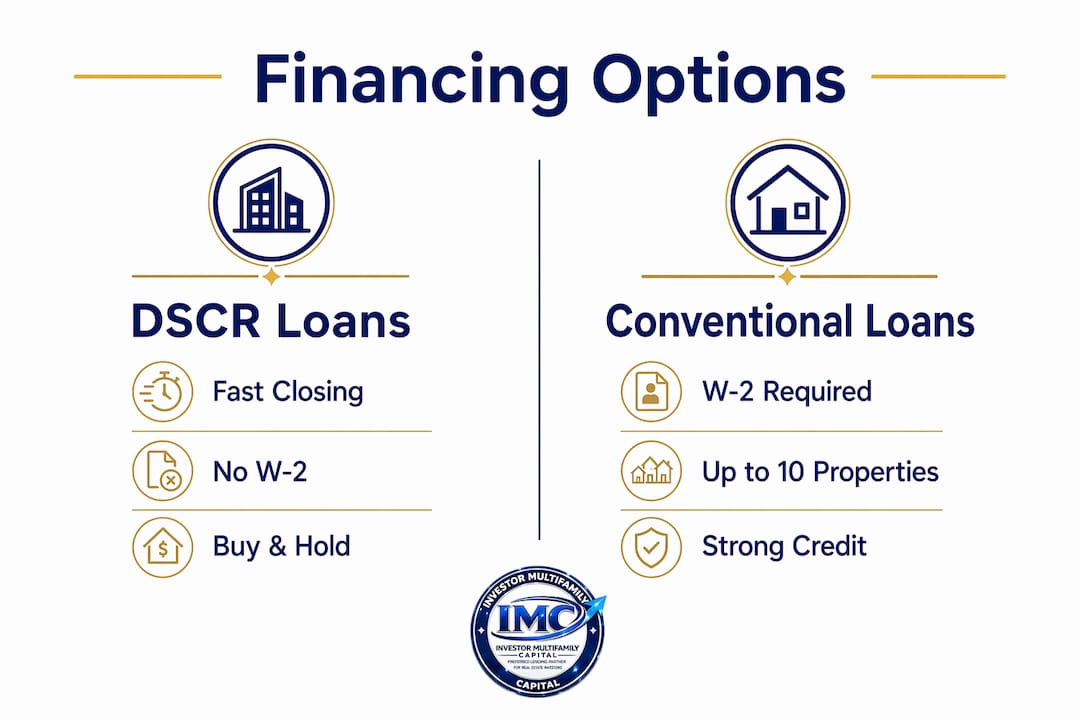
Real estate investors have several financing products built around property income. Each serves a different hold period, property type, and portfolio stage.
DSCR loans
DSCR loans are the primary tool for buy-and-hold investors. They close faster than conventional investment loans. DSCR loans close in 21–30 days, while conventional investment property loans typically take 30–60 days. That speed advantage matters in competitive markets where sellers favor certainty of close. DSCR programs also carry no limit on the number of financed properties, unlike conventional loans, which cap financed properties near 10. For investors building a portfolio beyond that threshold, DSCR is the only scalable path within standard lending.
Conventional investment loans
Conventional investment loans work well for investors with strong W-2 income and fewer than 10 financed properties. They require full income documentation, debt-to-income qualification, and typically carry stricter property condition standards. Down payments range from 15% to 30%, with interest rates running 1.0% to 2.0% above owner-occupied mortgage rates. These loans suit early-stage investors who have not yet maxed their conventional loan count.
Bridge loans and portfolio loans
Bridge loans fill the gap between acquisition and stabilization. An investor buys a distressed property, renovates it, leases it up, and then refinances into a DSCR loan once the property cash flows. Portfolio loans are held by the originating lender rather than sold to the secondary market. That gives lenders more flexibility on underwriting criteria, property condition, and borrower profile. They are a strong option when a property does not meet standard DSCR program guidelines.
Seller financing and creative structures
Seller financing removes the institutional lender entirely. The seller acts as the lender, and the investor makes payments directly to them. Terms are fully negotiable, including interest rate, amortization schedule, and balloon payment date. This structure works best when a seller has no mortgage to pay off and wants installment income rather than a lump sum.
| Financing type | Down payment | Closing speed | Best use case |
|---|---|---|---|
| DSCR loan | 20%–25% | 21–30 days | Buy-and-hold, portfolio scaling |
| Conventional investment loan | 15%–30% | 30–60 days | Early-stage investors, under 10 properties |
| Bridge loan | 20%–30% | 10–21 days | Acquisition before stabilization |
| Portfolio loan | Varies | 21–45 days | Non-standard properties or borrowers |
| Seller financing | Negotiable | Flexible | Off-market deals, motivated sellers |
How to qualify for property cash flow based financing
Qualification for financing based on rental income follows a defined sequence. Investors who prepare each element before submitting a deal close faster and at better terms.
-
Check your credit score. Pull your FICO score before approaching any lender. A 640 qualifies for most DSCR purchases, but a 700 or above opens better rate tiers and reduces reserve requirements. Resolve any collections or derogatory marks at least 60 days before applying.
-
Run the DSCR on the subject property. Divide the property’s annual net operating income by the annual debt service at your target loan amount. If the ratio falls below 1.20, either renegotiate the purchase price, increase the down payment to lower the debt service, or find a lender with a lower DSCR floor.
-
Gather your property documentation. Collect the current lease agreements, rent rolls, property tax bills, insurance declarations, and any HOA statements. For vacant properties, obtain a market rent analysis from a licensed appraiser or property manager before submitting.
-
Organize your financial package upfront. Incomplete loan documentation leads to conservative, high-priced loan offers that are difficult to renegotiate once underwriting begins. Submit a complete package on day one: entity documents, bank statements showing reserves, and a property summary with photos.
-
Confirm your reserves. Most DSCR programs require three to six months of PITIA (principal, interest, taxes, insurance, and association dues) held in a verifiable account. Some lenders count retirement accounts at a discount. Know your reserve position before you submit.
-
Select the right loan program for the property type. A 2-4 unit DSCR loan underwrites differently than a single-family rental or a five-plus unit commercial property. Match the program to the asset class before you engage a lender.
Pro Tip: A complete, well-organized financial package does more than speed up underwriting. Upfront complete financial packages directly influence interest rate negotiation and loan pricing. Lenders price risk. When your file is clean, they see less risk and price accordingly.
How to troubleshoot common problems with cash flow based financing
Most DSCR loan problems fall into three categories: appraisal gaps, sub-DSCR ratios, and credit shortfalls. Each has a specific resolution path.
-
Appraisal rent comes in below the lease. The appraisal includes a market rent schedule that may differ from your current lease. If the appraiser’s rent estimate is lower, your DSCR drops below the minimum. Solutions include increasing the down payment to reduce debt service, disputing the rent comparable selection with documented market data, or switching to a lender with a lower DSCR floor.
-
DSCR ratio falls below 1.0. A sub-1.0 DSCR means the property does not cover its debt service at the proposed loan amount. Some lenders offer no-ratio DSCR products for experienced investors with strong credit and reserves. Alternatively, a larger down payment or a lower purchase price can restore the ratio.
-
Credit score gaps. If your FICO falls between 620 and 640, most DSCR programs are unavailable. A portfolio lender or private capital source may bridge the gap while you repair your credit profile. Do not apply to multiple lenders in quick succession, as hard inquiries compound the problem.
-
Unstable or seasonal cash flow. Short-term rental properties in markets like coastal Florida or New England ski towns show income volatility. Some lenders apply a vacancy factor that reduces effective gross income for DSCR calculation. Provide 12 months of actual rental income data and a property management agreement to support your income case.
If a lender declines your DSCR application, ask for the specific reason in writing before pursuing alternatives. A decline based on DSCR is a different problem than a decline based on credit or property condition. Each requires a different solution, and applying to the wrong next lender wastes time and generates unnecessary credit inquiries.
Investors who get declined often move too quickly to the next lender without fixing the root issue. Diagnose first, then act. If the property fundamentally does not cash flow at the proposed loan amount, no lender will approve it. Restructure the deal or walk away.
Key takeaways
Property cash flow based financing qualifies investors on rental income and DSCR metrics, not personal wages, making it the primary tool for scaling rental portfolios beyond conventional loan limits.
| Point | Details |
|---|---|
| DSCR is the core metric | Lenders require net operating income to exceed debt service, typically at a 1.20 ratio or above. |
| No personal income required | DSCR loans use no W-2s or tax returns, qualifying solely on property cash flow and credit profile. |
| Appraisal drives the income figure | Lenders use the appraiser’s market rent estimate, not the investor’s lease or projection. |
| Documentation quality affects pricing | A complete upfront file directly improves rate negotiation and reduces lender risk premiums. |
| DSCR loans scale without property caps | Unlike conventional loans capped near 10 properties, DSCR programs carry no financed property limit. |
What I’ve learned about structuring cash flow financing the right way
The most common mistake I see from investors is treating DSCR loans and business revenue loans as interchangeable. They are not. Confusing property cash flow financing with business revenue financing leads to mismatched loan products, higher costs, and deals that fall apart at the closing table. A DSCR loan underwrites the property. A business loan underwrites the operating company. Applying for the wrong one wastes weeks.
The investors who close the most deals are not the ones with the most cash. They are the ones who understand their financing stack. Seasoned investors use layered financing: conventional loans for early acquisitions, DSCR for buy-and-hold scaling, and hard money or bridge capital for renovations. Each tool has a specific job. Using a DSCR loan on a property that needs significant rehab is the wrong tool. Using a bridge loan on a stabilized cash-flowing asset is equally wrong.
I also see investors underestimate how much the rate spread matters at scale. Lenders apply a credit spread of 1%–2% above primary residence rates for investment properties. On a $500,000 loan, a 0.25% rate difference is $1,250 per year. Across a ten-property portfolio, that is $12,500 annually. Submitting a clean, complete file is the single highest-return action an investor can take before closing.
— Joe
Investor MultiFamily Capital funds deals based on what the property earns
Investor MultiFamily Capital underwrites DSCR loans based on property cash flow, not personal income. No W-2s. No tax return analysis. Just the numbers the property produces.
Investor MultiFamily Capital serves real estate investors across Massachusetts, New Hampshire, Rhode Island, Connecticut, Maine, and Florida. Programs include DSCR, bridge, BRRRR, multifamily, fix-and-flip, cash-out refinance, and deal rescue financing. If you want to understand how to qualify for a cash flow based loan or you have a deal ready to move, submit it now. Apply Online or Submit a Deal to get a same-day review from an investor-focused underwriting team.
FAQ
What is a DSCR loan in simple terms?
A DSCR loan qualifies based on the rental income a property generates, not the borrower’s personal income. Lenders divide the property’s net operating income by its monthly debt service to determine eligibility.
What credit score do I need for a DSCR loan?
Most DSCR programs require a minimum 640 FICO for purchases and 660 for refinances. First-time investors typically need 700 or above.
How many properties can I finance with DSCR loans?
DSCR loans carry no limit on the number of financed properties. Conventional investment loans cap out near 10 financed properties, making DSCR the standard path for portfolio scaling beyond that threshold.
What happens if the appraiser’s rent estimate is lower than my lease?
The lender uses the appraiser’s market rent figure, not your current lease, for the DSCR calculation. A lower appraised rent reduces your DSCR, which may require a larger down payment or a lender with a lower DSCR minimum.
How fast do DSCR loans close?
DSCR loans typically close in 21–30 days, compared to 30–60 days for conventional investment property loans. A complete documentation package submitted upfront is the fastest way to hit the lower end of that range.
Investor-only. Business-purpose investment property financing only. Not for owner-occupied or primary residence loans.