TL;DR:
- NH real estate investor loans are business-purpose loans based on property income, not personal income, enabling faster acquisitions. DSCR and bridge loans are the main types, with DSCR loans qualifying assets through rent income and bridge loans providing short-term funding for timing gaps or renovations. NH’s lack of income tax enhances rental cash flow, supporting strong debt coverage ratios and favorable borrowing conditions for investors.
An NH real estate investor loan is a business-purpose loan that qualifies based on property income, not personal income, giving New Hampshire investors a faster path to acquisition and portfolio growth. DSCR loans and bridge loans are the two most widely used structures in this category. New Hampshire’s lack of a state income tax makes rental cash flow more attractive than in most New England states, and strong rental demand in markets like Manchester, Portsmouth, and the Lakes Region supports solid debt coverage ratios. This guide covers how each loan type works, what qualifies, and how to apply.
What is an NH real estate investor loan and how does it work?
An NH real estate investor loan finances investment properties using the property’s cash flow as the primary qualification metric. The lender calculates the Debt Service Coverage Ratio, or DSCR, by dividing monthly rental income by monthly debt service (principal, interest, taxes, insurance, and association dues). A DSCR of at least 1.0 is the minimum threshold to qualify, while a ratio of 1.25 or higher typically unlocks the best pricing. That formula means a property generating $2,500 per month in rent against $2,000 in monthly debt service carries a 1.25 DSCR and qualifies comfortably.

DSCR loans qualify assets, not borrowers. That distinction matters because conventional mortgages cap out at 10 financed properties and require full personal income documentation. DSCR loans have no such ceiling, which is why investors with growing portfolios rely on them. New Hampshire’s no state income tax environment amplifies this advantage. Rental income stays more intact, which improves DSCR calculations and makes deals pencil out that would not work in higher-tax states.
What are DSCR loans and why are they critical for NH investors?
DSCR loans are the primary tool for NH investors who want to scale without income documentation hurdles. New Hampshire DSCR loans require a minimum credit score of 620, with 680–700+ recommended for best pricing. Down payments range from 15% to 25% depending on the property type and borrower profile.
Key features of DSCR loans for NH investors:
- No personal income docs required. W-2s, tax returns, and pay stubs are not part of the file.
- Fast closings. Some NH DSCR loans close in 15 business days, compared to 30–45 days for conventional loans.
- Eligible property types include single-family rentals, 2–4 unit properties, multifamily buildings, and short-term rentals.
- STR income qualifies. NH investors in Lake Winnipesaukee and the White Mountains can use short-term rental income to satisfy DSCR requirements.
- Cash-out refinance available. Investors can access up to 75% LTV in equity without personal income documentation.
Manchester is NH’s largest rental market and supports consistent long-term tenant demand. Portsmouth attracts higher-income renters and commands premium rents. The Lakes Region, including Laconia and Meredith, generates strong Airbnb and VRBO revenue that qualifies under STR financing programs. Each of these markets produces the rental income that DSCR underwriting depends on.
Pro Tip: Target a DSCR of 1.25 or higher before submitting your loan file. Lenders price aggressively at that threshold, and the difference in rate between a 1.0 and a 1.25 DSCR can meaningfully affect your cash-on-cash return.
How do bridge loans work for NH investors and when should you use them?
A bridge loan is short-term financing that covers the gap between acquisition and permanent financing or a sale. Bridge loans serve as interim financing until a DSCR loan, conventional refinance, or property sale closes. Terms typically run 6–24 months. Approval is based primarily on the property’s value and the investor’s exit strategy, not personal income.
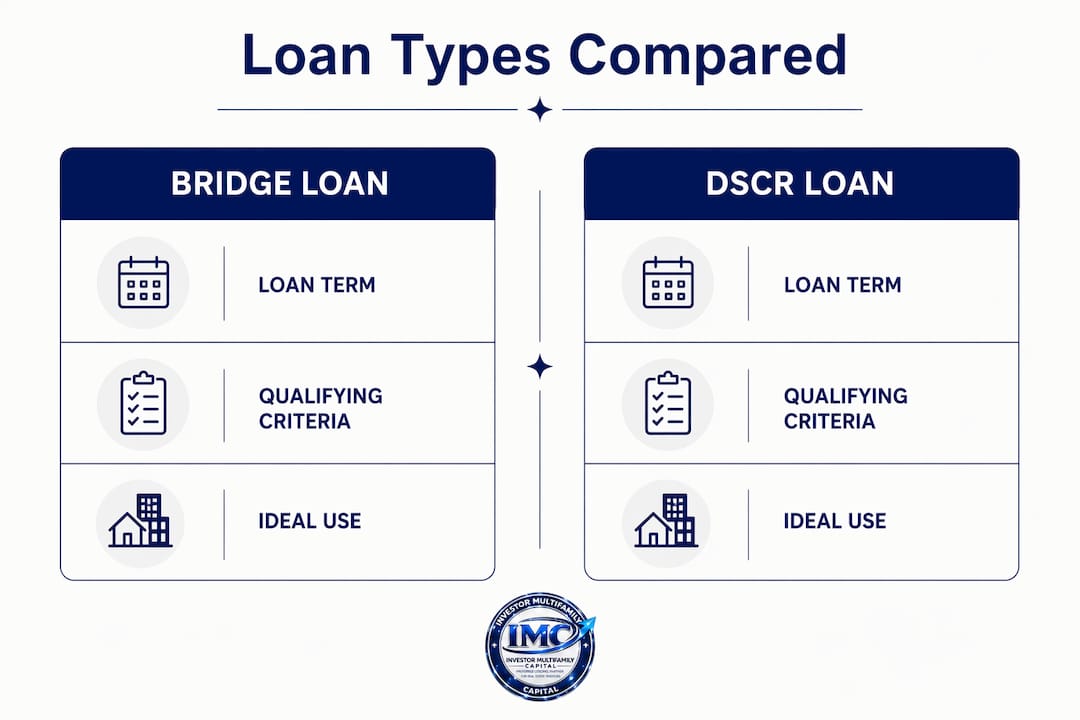
The table below compares bridge loans and DSCR loans for NH investors:
| Feature | Bridge Loan | DSCR Loan |
|---|---|---|
| Loan term | 6–24 months | 30-year fixed or ARM |
| Qualification basis | Asset value and exit strategy | Property cash flow (DSCR ratio) |
| Best use case | Fix and flip, quick acquisition | Long-term rental hold |
| Income docs required | No | No |
| Closing speed | Fast (days to weeks) | As fast as 15 business days |
| Typical LTV | Up to 75–80% | Up to 75–80% |
Bridge loans are the right tool when timing is the constraint. An investor who finds an off-market duplex in Concord but needs to close in 10 days cannot wait for DSCR underwriting. A bridge loan closes the deal. The investor then stabilizes the property, establishes rental income, and refinances into a DSCR loan for long-term hold.
Fix-and-flip projects in NH also rely on bridge financing. The investor buys a distressed property, completes renovations, and either sells or refinances. Fix-and-flip loans operate on the same short-term logic. The exit is built into the loan structure from day one.
Pro Tip: Always have your exit strategy documented before you apply for a bridge loan. Lenders underwrite the exit, not just the entry. A clear refinance plan or sale timeline speeds approval and improves terms.
How to qualify and apply for an NH property investment loan
Qualifying for an NH investor loan follows a defined sequence. Skipping steps creates delays.
-
Check your credit score. Pull your credit report before applying. A 620 score is the floor for most DSCR programs. A 700+ score puts you in the best pricing tier. Dispute errors before submitting any loan file.
-
Analyze the property’s cash flow. Calculate the DSCR using the formula: monthly gross rent divided by monthly PITIA. If the ratio is below 1.0, the deal does not qualify under standard DSCR programs. Adjust the purchase price or find a property with stronger rent.
-
Prepare your asset documentation. DSCR loans do not require income docs, but lenders verify reserves. Most programs require 3–6 months of PITIA in liquid reserves after closing. Document bank and investment accounts.
-
Order a rent schedule or lease. The appraiser will provide a market rent analysis (Form 1007 or equivalent). Existing leases strengthen the file. For STR properties, 12 months of platform revenue history from Airbnb or VRBO supports the income figure.
-
Choose the right lender. Broker networks like Lendmire specialize in NH investor loans and have access to multiple DSCR and bridge programs. Investor MultiFamily Capital offers DSCR loans in New Hampshire with underwriting based on property cash flow. Matching the loan type to the deal structure matters more than chasing the lowest rate.
-
Submit a complete file. Incomplete files cause the most delays. Include the purchase contract, entity documents (LLC or trust), property insurance binder, and any existing leases. For a bridge loan, include your renovation budget and exit strategy memo.
-
Understand the appraisal. For DSCR loans, the appraisal must confirm both market value and stabilized rental income. A low rent estimate from the appraiser can reduce your loan amount even if the purchase price is solid. Review comparable rentals in the area before the appraisal is ordered.
What other financing options should NH investors consider?
DSCR and bridge loans cover most scenarios, but NH investors benefit from knowing the full toolkit. Creative financing strategies including seller financing, hard money loans, joint ventures, and layered capital stacks remain relevant for deals that fall outside standard underwriting.
Options worth evaluating:
- Seller financing. The seller acts as the lender. This bypasses traditional underwriting entirely. Motivated sellers sometimes prefer installment sales for tax structure reasons, which creates negotiating room for investors. This works best on off-market deals where the seller has equity and flexibility.
- Hard money loans. Asset-based lending with higher rates and shorter terms. Useful when speed is the only priority and the investor has a clear, short exit. Hard money is more expensive than bridge loans from institutional lenders, so it fits narrow scenarios.
- Layered capital stacks. Combining a DSCR loan with seller financing on a second position, or pairing bridge financing with a JV equity partner, reduces the investor’s cash outlay. This structure works on larger multifamily acquisitions where the numbers support multiple capital layers.
- BRRRR strategy loans. Buy, Rehab, Rent, Refinance, Repeat. The investor uses a bridge loan to acquire and renovate, then refinances into a DSCR loan once the property is stabilized. Timing the appraisal is critical in this model. Refinancing too early limits the LTV and reduces the equity pulled out.
NH’s no-income-tax environment makes all of these structures more attractive. Rental cash flow is not eroded by state-level taxation, which improves returns across every financing structure. Investors running the BRRRR method in NH keep more of the spread between rent and debt service than they would in Massachusetts or Connecticut.
Key takeaways
NH real estate investors get the best financing results by matching the loan type to the deal structure, using DSCR loans for long-term holds and bridge loans for acquisitions that require speed or renovation.
| Point | Details |
|---|---|
| DSCR qualifies the property | Rental income divided by debt service must reach 1.0 minimum; 1.25+ gets best pricing. |
| No income docs required | DSCR and bridge loans skip W-2s and tax returns, enabling portfolio scaling. |
| Bridge loans cover timing gaps | Use bridge financing for fast acquisitions and fix-and-flip projects before refinancing. |
| NH tax environment helps | No state income tax improves rental cash flow and strengthens DSCR calculations. |
| STR income qualifies | Short-term rental revenue from Airbnb and VRBO counts toward DSCR in NH markets. |
What I’ve learned about NH investor financing after working hundreds of deals
The biggest mistake I see NH investors make is treating DSCR loans like conventional mortgages. They wait until they have a perfect credit profile and a fully stabilized property before applying. That caution costs them deals. DSCR underwriting is built for investors who move fast. The qualification criteria are clear, the documentation is minimal, and lenders who specialize in this space make decisions quickly.
The second mistake is underestimating the appraisal. I have watched deals fall apart not because the purchase price was wrong, but because the appraiser’s rent estimate came in below market. That single number drives the DSCR calculation, which drives the loan amount. Investors who do their own rent comps before ordering the appraisal rarely get surprised. Those who skip that step sometimes do.
Bridge loans are underused in NH. Investors see the short term and higher cost and default to waiting for a DSCR loan. But a bridge loan that closes a deal in 10 days is worth more than a DSCR loan that takes 30 days and loses the deal. The cost of the bridge is a rounding error compared to the cost of missing the acquisition.
NH’s market fundamentals are strong for investors in 2026. Rental demand in Manchester and Portsmouth remains tight. The Lakes Region and White Mountains continue to generate STR revenue that supports DSCR qualification. Investors who understand how to qualify for a DSCR loan and when to use bridge financing have a structural advantage over investors still relying on conventional mortgages.
— Joe
How Investor MultiFamily Capital funds NH investment deals
Investor MultiFamily Capital provides business-purpose financing for NH real estate investors across DSCR, bridge, fix-and-flip, BRRRR, and multifamily loan programs. Qualification is based on property cash flow, not personal income, which means faster approvals and no W-2 requirements.
NH investors can access DSCR loan programs for long-term rental holds and bridge loans in New Hampshire for acquisitions that require speed. Investor MultiFamily Capital serves investors across Manchester, Portsmouth, Concord, the Lakes Region, and the White Mountains. Submit a Deal or Run Deal Analysis to get your scenario reviewed by an investor-focused underwriting team.
Investor-only. Business-purpose investment property financing only. Not for owner-occupied or primary residence loans.
FAQ
What is a DSCR loan in New Hampshire?
A DSCR loan is a business-purpose mortgage that qualifies based on rental income rather than personal income. The property’s monthly rent must cover its monthly debt service at a ratio of at least 1.0 to qualify.
What credit score is needed for an NH investor loan?
Most NH DSCR programs require a minimum credit score of 620, with 680–700+ recommended for the best available pricing and terms.
How fast can an NH bridge loan close?
Bridge loans close faster than DSCR loans and can fund in days to a few weeks depending on the lender and deal complexity. DSCR loans from specialized lenders close in as few as 15 business days.
Can short-term rental income qualify for a DSCR loan in NH?
Yes. Short-term rental income from platforms like Airbnb and VRBO qualifies for DSCR loans in NH markets including Lake Winnipesaukee and the White Mountains, provided the income history supports the required debt coverage ratio.
What is the difference between a bridge loan and a DSCR loan for NH investors?
A bridge loan is short-term financing used for acquisitions and renovations before permanent financing is in place. A DSCR loan is a long-term hold product based on stabilized rental income. Most investors use bridge financing to acquire and renovate, then refinance into a DSCR loan.