TL;DR:
- A DSCR loan in Massachusetts relies on a property’s rental income rather than personal income, making it ideal for investors with multiple properties. High property values and zoning complexities demand lender expertise, and pre-qualifying with a lender offers a significant competitive advantage. Preparation, including understanding DSCR requirements and building lender relationships beforehand, is crucial for timely deal closing.
A DSCR loan is defined as a mortgage that qualifies based on a property’s rental income rather than the borrower’s personal income, making it the primary financing tool for Massachusetts real estate investors who hold multiple properties or operate through LLCs. The debt service coverage ratio (DSCR) divides gross monthly rent by total monthly debt obligations. Lenders typically require a DSCR at or above 1.0, though many set their floor at 1.25. Massachusetts is one of the most demanding markets for this product: Boston’s median home price exceeds $745,000, and Cambridge and Somerville multifamily acquisitions routinely surpass $1 million. That price pressure makes rental income verification the critical variable in every deal. Investor MultiFamily Capital structures DSCR loans in Massachusetts specifically for investors navigating these conditions.
What qualifications do Massachusetts investors need for a DSCR loan?

DSCR loans require less personal income documentation than conventional mortgages. Many Massachusetts lenders waive full personal income verification, relying instead on the property’s net operating income (NOI) and rent roll. That shift benefits investors with complex tax returns, self-employment income, or portfolios that show paper losses due to depreciation.
Core financial thresholds
The minimum DSCR ratio most lenders accept is 1.0, meaning rent exactly covers debt service. A ratio of 1.25 or higher signals stronger cash flow and typically unlocks better terms. Loan-to-value ratios on Massachusetts DSCR programs reach up to 80%, which means investors should budget for a down payment in the 20%–25% range, though some programs allow as low as 10% depending on property type and credit profile.
Eligible property types
- Single-family rentals (1–4 units)
- Multifamily properties (5+ units, underwritten separately)
- Condominiums meeting lender warrantability standards
- Mixed-use commercial-residential hybrids common in Boston, Worcester, and Springfield
- Short-term rentals on Cape Cod, Nantucket, and Martha’s Vineyard
Some lenders require LLC ownership for mixed-use or commercial-residential hybrid properties. Holding the asset in an LLC also aligns with business-purpose lending requirements and limits personal liability.
Short-term rental income
Short-term rental income qualifies when lenders accept projected revenue validated by tools like AirDNA. Local regulatory compliance matters: Cape Cod towns and island communities each have their own short-term rental registration rules. Investors must document compliance before a lender will credit projected income. For a deeper look at STR financing, Investor MultiFamily Capital covers Airbnb and STR financing specific to Massachusetts markets.
| Qualification Factor | Typical Requirement |
|---|---|
| Minimum DSCR ratio | 1.0–1.25 depending on lender |
| Maximum LTV | Up to 80% |
| Down payment range | 10%–25% |
| Property ownership | LLC often required for mixed-use |
| STR income validation | AirDNA projections plus local compliance |
Pro Tip: Calculate your DSCR before you apply. Divide gross monthly rent by your projected monthly principal, interest, taxes, insurance, and HOA costs. A ratio below 1.0 signals a deal that needs repricing or restructuring before submission.
How do you choose the right DSCR lender in Massachusetts?
Lender selection is the single most consequential decision in a Massachusetts DSCR deal. The state’s historic zoning, high property values, and commercial-residential hybrids create underwriting complexity that generic national lenders routinely mishandle. Regional lenders with local expertise navigate Boston’s zoning and appraisal challenges far more effectively than lenders without Massachusetts market experience.
Direct lenders vs. mortgage brokers
Direct lenders control their own underwriting, which means faster decisions and clearer communication. Mortgage brokers specializing in DSCR loans access multiple wholesale lenders, which creates flexibility for complex deals that one lender might decline. That flexibility matters when your property sits in a historic district or straddles a commercial-residential zoning line.
Key criteria to evaluate before committing
- DSCR floor. Confirm the lender’s minimum ratio. A floor of 1.0 gives you more room than a floor of 1.25 on a tight deal.
- Origination fees. Fees range from 0% to approximately 2% across Massachusetts lenders. On a $1 million acquisition, that spread equals $20,000 in upfront cost.
- Property type acceptance. Confirm the lender finances your specific asset class, including mixed-use, historic, or STR properties.
- Turnaround time. Competitive Massachusetts markets move fast. A lender who takes 45 days to close loses you deals.
- LLC and entity requirements. Verify whether the lender requires or prefers LLC ownership for your property type.
Pro Tip: Ask every lender for a sample term sheet before submitting a full application. Comparing term sheets side by side reveals fee structures and DSCR floors that marketing materials often obscure.
Investor MultiFamily Capital operates as a direct lender with deep Massachusetts market knowledge, covering single-family rentals, multifamily assets, and STR properties across the state. Investors can review DSCR loan qualifications before submitting a deal.
How do you apply and close a DSCR loan in Massachusetts?
Preparation separates investors who close in 21 days from those who stall in underwriting for two months. Organizing documents before you contact a lender compresses the timeline and signals professionalism to underwriters.
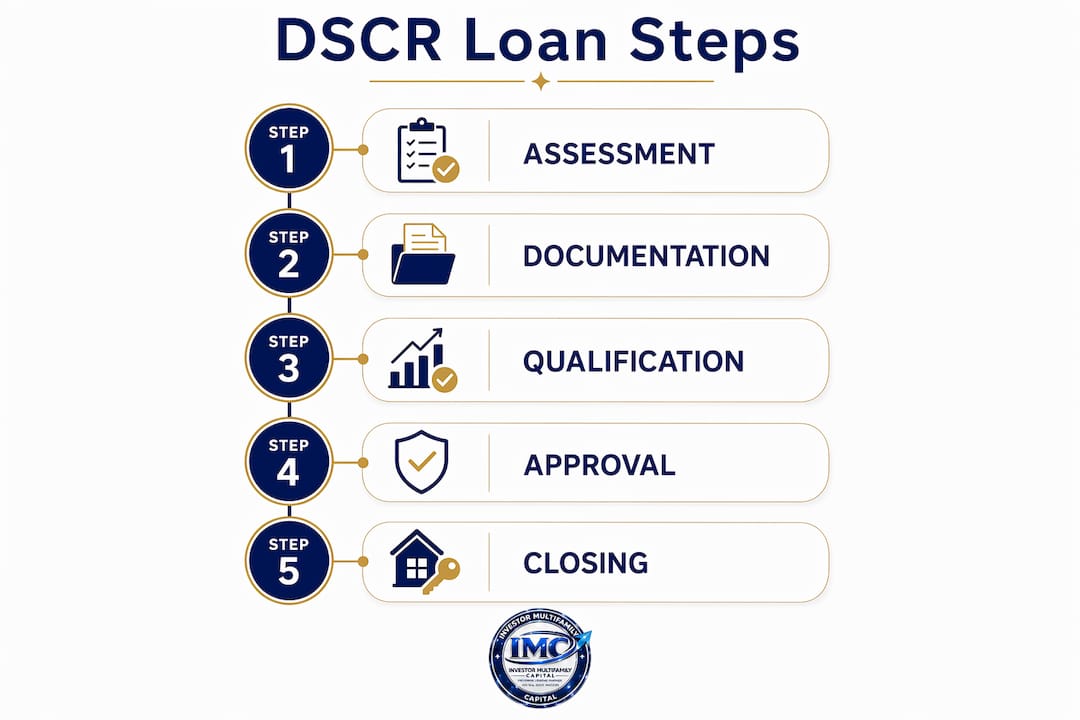
Step-by-step application process
- Compute your DSCR. Gather current leases or market rent comparables. Divide gross monthly rent by total monthly debt service. Confirm the ratio meets your target lender’s floor.
- Assemble your document package. Collect the current rent roll, executed leases, a 12-month operating expense statement, property tax bills, insurance declarations, and any HOA statements.
- Prepare the entity documents. If the property is held in an LLC, gather the operating agreement, articles of organization, and an EIN confirmation letter.
- Submit the application. Direct lenders accept submissions online or through a loan officer. Brokers route your package to the most suitable wholesale lender based on your deal profile.
- Support the appraisal. Massachusetts appraisals on historic or mixed-use properties can be complex. Provide the appraiser with rent comparables and any recent capital improvements to support value.
- Respond to underwriting conditions promptly. Underwriters issue conditions, which are requests for additional documentation. Slow responses are the leading cause of closing delays.
- Review the closing disclosure. Confirm origination fees, prepayment penalty terms, and escrow requirements match the term sheet before signing.
Common documentation mistakes to avoid
- Submitting unsigned or expired leases
- Failing to document STR income with AirDNA reports and local registration certificates
- Providing operating statements that exclude property management fees, inflating NOI
- Missing LLC documentation when the lender requires entity ownership
Pro Tip: If your property is vacant or newly acquired, use a market rent analysis from a licensed appraiser rather than a self-prepared estimate. Lenders weight third-party rent opinions more heavily than investor projections.
Massachusetts closing timelines for DSCR loans typically run 21–45 days for straightforward deals. Historic properties, mixed-use assets, or deals requiring zoning verification can extend to 60 days. Build that buffer into your purchase and sale agreement.
What pitfalls do Massachusetts investors face with DSCR loans?
Massachusetts is not a forgiving market for underprepared investors. High acquisition costs, complex zoning, and competitive bidding create specific friction points that derail DSCR deals at predictable stages.
- DSCR ratio shortfalls. High purchase prices compress cash-on-cash returns. A property priced at $900,000 with $5,500 in monthly rent may not clear a 1.25 DSCR floor. Investors must either negotiate the price down, increase the down payment to reduce debt service, or find a lender with a 1.0 floor.
- Historic and mixed-use appraisal challenges. Properties in Boston’s South End, Beacon Hill, or Worcester’s Canal District often receive conservative appraisals due to limited comparable sales. Structuring DSCR financing for properties in historic districts requires a lender with appraisal expertise in those zones.
- Origination fee surprises. Fee ranges across Massachusetts lenders vary widely. Investors who skip the term sheet comparison step often discover fee differences at closing, when renegotiation is difficult.
- Unverifiable STR income. Lenders who accept AirDNA projections still require proof of local registration and compliance. A Cape Cod property without a town-issued STR permit cannot use projected rental income in the DSCR calculation.
- Timing pressure in competitive markets. Multiple-offer situations require fast financing. Investors who have not pre-qualified with a DSCR lender lose deals to cash buyers or investors with established lender relationships.
“The investors who close the most deals in Massachusetts are not the ones with the most capital. They are the ones with a lender relationship already in place before the deal hits the market. Speed is the competitive advantage that DSCR financing enables when you have done the preparation work.”
Pro Tip: Use a cash-out refinance on an existing property to fund the down payment on a new acquisition. Investor MultiFamily Capital offers cash-out refinancing structured around DSCR underwriting, which preserves your liquidity without requiring personal income documentation.
Key Takeaways
A DSCR loan in Massachusetts qualifies based on property rental income, not personal tax returns, making it the most practical financing tool for investors operating in a high-value, competitive market.
| Point | Details |
|---|---|
| DSCR ratio threshold | Most lenders require 1.0–1.25; higher ratios unlock better terms. |
| LTV and down payment | Programs reach up to 80% LTV, with down payments typically in the 20%–25% range. |
| Lender selection | Regional expertise matters; choose lenders who understand Massachusetts zoning and property types. |
| STR income documentation | AirDNA projections plus local registration proof are required to count short-term rental income. |
| Preparation speed | Pre-qualifying with a lender before deal sourcing is the primary competitive advantage in Massachusetts. |
What I’ve learned from DSCR deals in Massachusetts
The investors I see struggle most with DSCR financing in Massachusetts are not struggling because of bad properties. They are struggling because they treat the lender relationship as a transaction rather than a working partnership. Massachusetts deals have layers: historic designations, zoning overlays, condo conversion restrictions, and STR regulations that vary town by town. A lender who has never underwritten a triple-decker in Somerville or a mixed-use building in Lowell will create problems at the appraisal stage that no amount of documentation can fix quickly.
My strongest recommendation is to build the lender relationship before you need it. Run a hypothetical deal through Investor MultiFamily Capital’s process before you are under contract. Understand their DSCR floor, their LLC requirements, and their turnaround time. That knowledge changes how you write offers and how you structure your entity.
The other pattern I see consistently: investors underestimate the impact of origination fees on total deal cost. A 2% origination fee on a $1.2 million multifamily acquisition is $24,000 out of pocket at closing. That is real money that affects your cash-on-cash return in year one. Compare term sheets, not just rates.
Massachusetts rental demand is strong, and DSCR financing is the right tool for this market. The investors who use it well are the ones who treat preparation as a competitive advantage, not a formality.
— Joe
Investor MultiFamily Capital’s DSCR loan programs for Massachusetts investors
Investor MultiFamily Capital structures DSCR loans specifically for Massachusetts investment properties, from single-family rentals in Worcester to multifamily assets in Boston and STR properties on Cape Cod.
Underwriting is based on property cash flow, not personal income. Programs cover single-family, multifamily, mixed-use, and short-term rental properties across Massachusetts. Investors can apply for DSCR financing or review the full program details before submitting a deal. For Massachusetts-specific scenarios, the DSCR loan options page covers eligible property types, LTV limits, and documentation requirements. Submit a Deal or Run Deal Analysis to get a fast response from the Investor MultiFamily Capital team.
FAQ
What is the minimum DSCR ratio for Massachusetts investment properties?
Most Massachusetts DSCR lenders set a minimum ratio of 1.0, meaning rent covers debt service exactly. Lenders with stricter underwriting require 1.25 or higher.
Do DSCR loans in Massachusetts require personal income documentation?
DSCR loans focus on property cash flow rather than personal earnings. Many Massachusetts lenders waive full personal income verification, though credit score and entity documentation are still required.
Can short-term rental income count toward the DSCR calculation?
Short-term rental income qualifies when lenders accept AirDNA projections and the investor provides proof of local STR registration and regulatory compliance.
What property types qualify for DSCR loans in Massachusetts?
Eligible properties include single-family rentals, multifamily buildings, condominiums, and mixed-use commercial-residential hybrids. LLC ownership is often required for mixed-use assets.
How long does it take to close a DSCR loan in Massachusetts?
Standard deals close in 21–45 days. Historic properties, mixed-use assets, or deals requiring zoning verification typically extend to 60 days.
Investor-only. Business-purpose investment property financing only. Not for owner-occupied or primary residence loans.