TL;DR:
- Multifamily syndication pools investor capital to acquire and operate large apartment properties through a sponsor and passive investors. The structure offers access to institutional-scale deals, with limited partners earning passive income and the sponsor managing all operations. Investors should carefully review deal terms, waterfall protections, and compliance requirements before participating.
Multifamily syndication is defined as a structure where multiple investors pool capital to collectively acquire and manage apartment buildings or similar multifamily properties. The industry term is “real estate syndication,” and it operates through a formal partnership between a sponsor and passive investors. Syndication deals include partnership agreements, SEC disclosures, and a general partner who sources, underwrites, and manages the asset while limited partners provide most of the equity and stay passive. This model gives individual investors access to large commercial deals they could not buy alone, making it one of the most practical entry points into institutional-scale real estate.
What is multifamily syndication and how does it work?
Multifamily syndication involves a sponsor pooling capital from passive investors to buy and operate apartment properties under LLC or limited partnership structures. The sponsor, also called the general partner (GP), handles every active responsibility: finding the deal, securing financing, managing the property, and executing the business plan. Limited partners (LPs) contribute capital and receive returns without taking on day-to-day management duties.

The properties involved are typically apartments, condos, and townhouses with five or more units. Sponsors use data platforms like CoStar, RealPage, and Yardi to underwrite deals with reliable rent rolls and market comparables. That data infrastructure is one reason multifamily attracts institutional and private capital at scale.
Multifamily investment groups form around individual deals or ongoing fund structures. Each deal is governed by a Private Placement Memorandum (PPM) and subscription agreements that define investor rights, fee structures, and distribution rules. The LLC or limited partnership entity holds title to the property and separates investor liability from personal assets.
Roles, structures, and financial arrangements in syndications
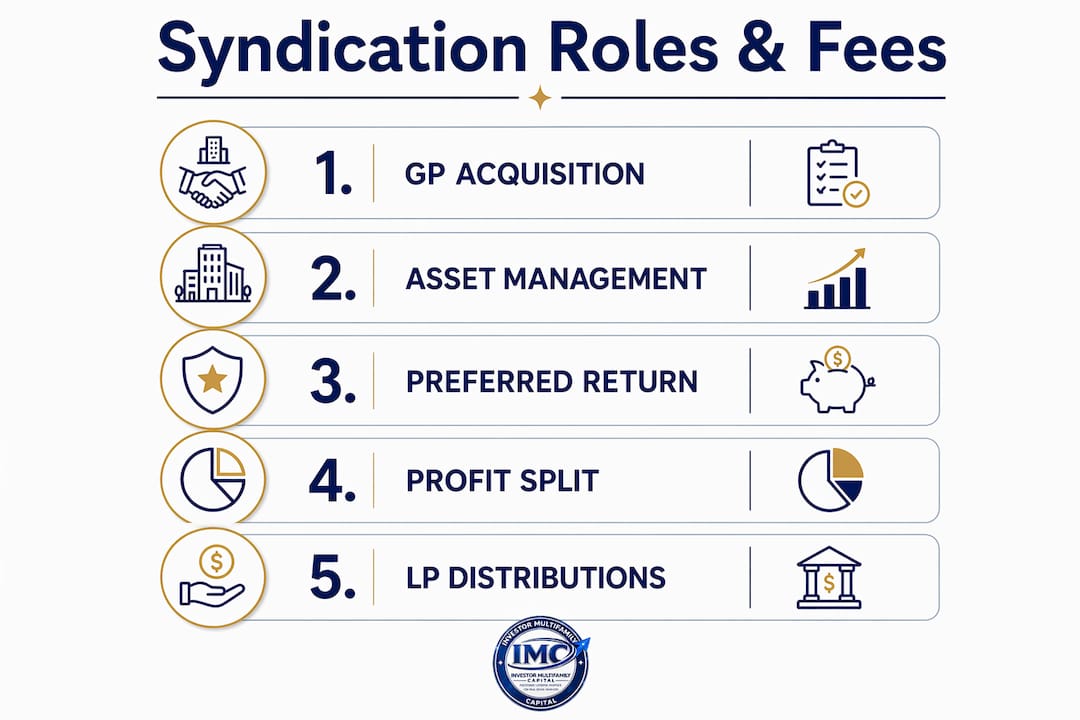
The GP and LP roles divide responsibilities cleanly. The GP earns an acquisition fee, asset management fee, and a share of profits called the “promote.” The LP earns passive income and a share of appreciation without managing anything.
Typical syndications target about 20–25% equity from investors, with the remaining balance financed through acquisition loans. That means a $10,000,000 apartment purchase might require $2,000,000–$2,500,000 in LP equity, with the rest covered by debt. Minimum investment commitments commonly range from $25,000 to $100,000 per investor.
Key structural elements include:
- Entity type: Most deals use an LLC or limited partnership to hold the property and define ownership percentages.
- PPM: The Private Placement Memorandum discloses all material risks, fees, and terms. Read it in full before committing capital.
- Subscription agreement: The document you sign to formally invest and confirm your accredited investor status.
- Capital call timing: Funds are typically wired at closing or in tranches tied to construction draws.
- Asset management fee: The GP charges an ongoing fee, often 1–2% of collected revenue, to manage operations.
Pro Tip: Ask the sponsor for a copy of the operating agreement before signing the subscription agreement. The operating agreement controls voting rights, removal provisions, and distribution mechanics that the PPM may summarize but not fully detail.
How does the distribution waterfall work?
The waterfall structure governs how cash flow and sale proceeds are distributed between LPs and the GP. Waterfall distributions pay LPs their return of capital and a preferred return before the sponsor earns any promote share. This sequencing is the primary investor protection in syndication economics.
A typical waterfall moves through four tiers:
| Tier | Who Gets Paid | What They Receive |
|---|---|---|
| 1. Return of capital | LPs first | Original invested equity returned in full |
| 2. Preferred return | LPs first | Cumulative 6–8% annual return on invested capital |
| 3. Catch-up | GP | Sponsor receives distributions until it reaches its promote percentage |
| 4. Residual split | LP/GP | Remaining profits split 70/30 or 80/20 (LP/GP) |
The preferred return is often cumulative, meaning unpaid returns accrue and must be paid before the sponsor earns any profit share. That single term materially changes multi-year investor economics. A non-cumulative preferred return does not accrue, which benefits the sponsor in years with low cash flow.
Pro Tip: Always confirm whether the preferred return is cumulative and what capital base it applies to. Some deals calculate the preferred return on contributed equity only; others include reinvested distributions. The difference compounds significantly over a 5-year hold.
What compliance and tax rules apply to syndication investors?
Most multifamily syndications raise capital under SEC Regulation D. Rule 506(b) and 506© are the two most common exemptions, and they differ in one critical way: 506© allows general solicitation (public advertising) but requires formal accredited investor verification before accepting any investment.
Key compliance and tax points every investor needs to understand:
- Rule 506(b): No general solicitation allowed. Up to 35 non-accredited but sophisticated investors permitted. Self-certification of accredited status is acceptable.
- Rule 506©: General solicitation allowed. All investors must be accredited. Formal verification requires documented evidence such as tax returns, brokerage statements, or a letter from a licensed CPA or attorney.
- Accredited investor standard: Net worth over $1,000,000 excluding primary residence, or annual income over $200,000 ($300,000 joint) for the past two years.
- Schedule K-1: Investors receive a K-1 form reporting their share of income, deductions, and distributions. K-1s typically arrive later than standard 1099s because partnerships finalize depreciation and cost segregation accounting after year-end.
- Cash flow vs. taxable income: Depreciation deductions often make taxable income lower than actual cash distributions. Investors commonly receive cash while reporting a paper loss on their K-1.
Plan to file a tax extension in years when you hold syndication interests. K-1 delivery delays are normal, not errors, and filing before receiving your K-1 creates amendment risk.
What are the benefits and risks of multifamily syndications?
Multifamily syndications offer access to large apartment deals that individual investors cannot buy alone. A $15,000,000 apartment complex in Boston or Tampa is out of reach for most solo investors, but a syndication structure makes it accessible with a $50,000 check. That access is the core value proposition.
The primary benefits include:
- Passive income: LPs receive quarterly or monthly distributions without managing tenants, maintenance, or leasing.
- Professional management: The GP and its property management team handle all operations.
- Diversification: A single LP investment can represent exposure to 50–200 units across one or more markets.
- Tax efficiency: Depreciation and cost segregation often shelter cash distributions from current-year taxes.
The risks are real and should not be minimized. Hold periods typically run 3–7 years, and your capital is illiquid for that entire window. Interest rate increases raise refinancing costs and compress exit valuations. Sponsor execution risk is significant. A poorly managed value-add plan can destroy returns even in a strong market. Due diligence on the sponsor’s track record is not optional. Review a multifamily portfolio strategy before committing to any single deal.
How to participate in a multifamily syndication
The process of investing in a syndication follows a clear sequence. Skipping any step increases risk.
- Research sponsors. Review the GP’s track record, prior deal performance, and investor communication history. Ask for references from past LPs.
- Evaluate the deal. Review the offering memorandum for projected returns, market assumptions, and exit strategy. Stress-test the projections against higher vacancy and higher interest rates.
- Read the PPM. The Private Placement Memorandum is the legal disclosure document. Have a real estate attorney review it if you are investing $50,000 or more.
- Complete accredited investor verification. Under Rule 506©, verification requires documentation before your investment is accepted. Prepare tax returns, brokerage statements, or a professional letter in advance.
- Sign the subscription agreement. This formalizes your investment commitment and ownership percentage.
- Wire your capital. Funds are typically due at closing or per a capital call schedule tied to the business plan.
- Monitor during the hold. Expect quarterly investor reports covering occupancy, NOI, and distributions. K-1 tax forms arrive after year-end, often in march or april.
- Receive exit proceeds. At sale or refinance, the waterfall distributes capital and profits per the operating agreement.
Understanding multifamily financing mechanics helps LPs evaluate how the GP structures debt, which directly affects cash-on-cash returns and refinance risk during the hold.
Key Takeaways
Multifamily syndication gives passive investors access to institutional-scale apartment deals through a structured GP/LP partnership governed by SEC Regulation D, a waterfall distribution model, and Schedule K-1 tax reporting.
| Point | Details |
|---|---|
| GP/LP structure | The sponsor manages all operations; limited partners contribute capital and stay passive. |
| Equity and minimums | Deals typically target 20–25% equity, with minimum investments ranging from $25,000 to $100,000. |
| Waterfall protection | LPs receive return of capital and a 6–8% preferred return before the GP earns any promote. |
| SEC compliance | Most offerings use Rule 506(b) or 506©; 506© requires formal accredited investor verification. |
| K-1 timing | Schedule K-1 forms arrive after year-end due to partnership accounting; plan to file a tax extension. |
What I’ve learned from reviewing syndication deals
The most common mistake I see from new LP investors is focusing on the projected IRR and ignoring the waterfall details. A 17% projected IRR means nothing if the preferred return is non-cumulative, the catch-up tier is aggressive, and the GP is taking a 2% acquisition fee plus a 1.5% asset management fee on gross revenue. Model the fees first. Then model the waterfall. The IRR is the last number to trust.
The second mistake is underestimating K-1 complexity. Investors commonly misunderstand syndication returns because cash distributions and taxable income diverge significantly. You can receive $8,000 in cash distributions and report a $3,000 paper loss on your K-1 in the same year. That is not an error. It is cost segregation working as intended. But if you do not understand it going in, the K-1 will confuse your accountant and delay your filing.
My practical advice: build a relationship with the sponsor before you invest. Attend their webinars. Ask detailed questions about past deals that underperformed. How a GP handles a bad year tells you far more than their best-case projections. The sponsors worth backing answer hard questions directly and without defensiveness.
— Joe
Multifamily financing for syndication deals
Syndicators and co-investors working on apartment acquisitions in New England and Florida need financing that moves at deal speed. Investor MultiFamily Capital provides business-purpose multifamily financing for 5+ unit properties, structured around property cash flow rather than personal income.

Whether you are a GP closing a value-add acquisition or an LP co-investing alongside a sponsor, Investor MultiFamily Capital offers DSCR loans, bridge financing, and construction lending tailored to investor deal structures. Serving Massachusetts, New Hampshire, Rhode Island, Connecticut, Maine, and Florida. Submit a Deal or Apply Online to run your scenario with a team that understands syndication timelines and underwriting requirements.
FAQ
What is multifamily syndication in simple terms?
Multifamily syndication is a structure where a sponsor pools capital from passive investors to buy and manage apartment properties. The sponsor handles all operations; investors contribute equity and receive a share of income and profits.
How much money do you need to invest in a multifamily syndication?
Minimum investments typically range from $25,000 to $100,000 per deal, depending on the sponsor and total equity raise. Most offerings also require investors to meet the SEC’s accredited investor standard.
What is a preferred return in a syndication waterfall?
A preferred return is a minimum annual return, typically 6–8%, that limited partners receive before the sponsor earns any profit share. When cumulative, unpaid preferred returns accrue and must be satisfied before the GP participates in profits.
When do investors receive Schedule K-1 forms?
K-1 forms typically arrive after the standard tax deadline, often in march or april, because partnerships finalize depreciation and cost segregation accounting after year-end. Investors should plan to file a tax extension in years they hold syndication interests.
What is the difference between Rule 506(b) and Rule 506©?
Rule 506(b) prohibits general solicitation but allows up to 35 non-accredited investors with self-certification. Rule 506© permits public advertising but requires all investors to be accredited and formally verified before accepting capital.
Investor-only. Business-purpose investment property financing only. Not for owner-occupied or primary residence loans.
Recommended
- What Counts as Multifamily Property: 2026 Investor Guide | Investor MultiFamily Capital
- What Is Multifamily Financing? A 2026 Investor Guide | Investor MultiFamily Capital
- Build a Multifamily Portfolio Strategy That Scales | Investor MultiFamily Capital
- How to Finance a 5+ Unit Multifamily Property in 2026 | Investor MultiFamily Capital