TL;DR:
- A portfolio loan is a mortgage kept by the lender on its own books, allowing flexible approval criteria. It often serves real estate investors and those with complex or non-standard properties who are excluded by conventional lenders. Borrowers pay higher interest rates and fees but gain access to broader property types and customized loan terms.
A portfolio loan is a mortgage that a lender originates and keeps on its own books rather than selling to the secondary market. Because the lender retains the loan, it sets its own underwriting criteria and can approve borrowers who don’t qualify for conventional financing. This makes portfolio loans a practical tool for real estate investors, self-employed borrowers, and anyone financing complex or non-standard properties. If you’ve been turned down by traditional lenders or need terms that conforming loans can’t offer, understanding what is a portfolio loan could open doors that standard mortgage products close.
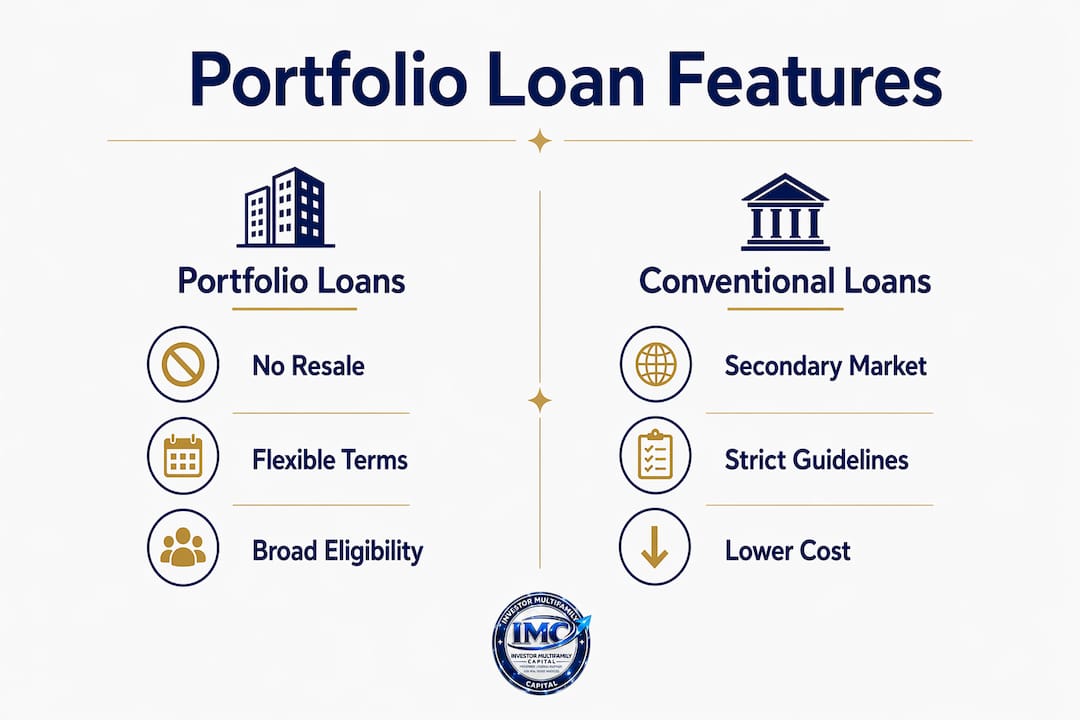
What is a portfolio loan and how does it differ from a conventional mortgage?

A portfolio loan is a mortgage kept on the lender’s books and never sold to Fannie Mae, Freddie Mac, or any other secondary market buyer. That single fact changes everything about how the loan is structured, priced, and approved.
Conventional conforming loans must meet strict agency guidelines. Lenders sell them quickly after origination, which means they have no incentive to approve anything outside those guidelines. A portfolio lender, by contrast, keeps the risk. That retained risk gives the lender full control over underwriting criteria, loan terms, and borrower eligibility.
The practical difference shows up at the application stage. A conventional lender checks your W-2s, runs your debt-to-income ratio against agency limits, and either approves or declines based on a fixed rulebook. A portfolio lender can weigh property cash flow, asset strength, and borrower history in a more flexible way. Portfolio loans are non-conforming products that exist specifically to serve borrowers and properties excluded by agency rules.
| Feature | Portfolio Loan | Conventional Loan |
|---|---|---|
| Sold to secondary market | No | Yes |
| Underwriting flexibility | High | Low |
| Credit requirements | Flexible | Strict (agency guidelines) |
| Property types eligible | Broad, including complex assets | Limited to conforming criteria |
| Interest rates | Typically higher | Typically lower |
| Availability | Limited, often unadvertised | Widely available |
One trade-off is cost. Lenders price retained risk into higher interest rates and fees. Investors who need the flexibility accept that cost as part of the deal structure.
What are the advantages and disadvantages of portfolio loans?
Portfolio loans carry real benefits, but they also come with costs that investors need to price into their deals before committing.
Advantages of portfolio loans:
- Flexible underwriting. Lenders evaluate the full borrower picture, not just a checklist. Self-employed investors, borrowers with recent credit events, and those with complex income structures can qualify.
- Wider property eligibility. Portfolio loans can finance 1–4 unit residential properties, mixed-use buildings, and higher-risk investment assets that conforming loans won’t touch.
- Custom loan terms. Lenders can negotiate interest-only periods, non-standard amortization schedules, and loan covenants tailored to the deal.
- Access for non-traditional borrowers. Portfolio loans provide financing for self-employed borrowers and those with recently re-established credit who are routinely passed over by conventional lenders.
Disadvantages of portfolio loans:
- Higher interest rates and fees. The lender prices the risk of holding the loan. Borrowers pay more than they would on a conforming mortgage.
- Prepayment penalties. Many portfolio loans include prepayment clauses that penalize early payoff. This directly affects exit strategy for investors.
- Limited availability. Many lenders don’t advertise portfolio loan products. Finding the right lender takes more effort than applying for a standard mortgage.
- Less regulatory protection. Because these loans fall outside agency guidelines, terms vary widely between lenders.
Pro Tip: Before signing any portfolio loan, request a full breakdown of prepayment penalties, release provisions, and any covenant restrictions. These terms affect your exit options more than the interest rate does.
The cost premium on a portfolio loan is real. For investors who can’t qualify for conventional financing or need to finance a property type that agencies won’t touch, that premium is often worth paying.
Who should consider a portfolio loan?
Portfolio loans are not the right fit for every borrower. They serve a specific set of profiles where conventional financing falls short.
- Self-employed investors and business owners. Borrowers who write off significant income on tax returns often show lower adjusted gross income than their actual cash flow. Portfolio lenders can underwrite based on bank statements or asset depletion rather than tax returns alone.
- Investors with multiple properties. Conventional lenders cap the number of financed properties. Portfolio lenders don’t operate under those same limits, making them a viable path for investors scaling a rental portfolio.
- Borrowers with recent credit events. A foreclosure, short sale, or bankruptcy within the past few years disqualifies most borrowers from agency loans. Portfolio loans serve borrowers who have re-established credit but don’t yet meet conventional seasoning requirements.
- Investors financing complex properties. Mixed-use buildings, properties with deferred maintenance, or assets with non-standard configurations often fail agency appraisal requirements. Portfolio lenders evaluate these deals on their own terms.
- Investors consolidating a rental portfolio. Rather than managing separate loans on each property, some investors use a single portfolio loan structured around the combined cash flow of multiple assets. This simplifies debt management and can improve overall LTV positioning.
The common thread across all these profiles is that the borrower or property doesn’t fit a standard template. Portfolio loans exist precisely to accommodate characteristics that conforming guidelines exclude.
How to apply for a portfolio loan
Applying for a portfolio loan requires more preparation than a conventional mortgage application. Lenders have more flexibility, but they also conduct a more thorough review of the full borrower and property picture.
Documentation you should prepare:
- Two years of personal and business tax returns
- Three to six months of bank statements
- A current rent roll if the property generates rental income
- Asset statements showing reserves and liquidity
- A property summary for complex or multi-unit assets
Credit score requirements vary by lender. Most portfolio lenders want to see a score above 620, though some will go lower if the property cash flow and borrower assets are strong. Debt-to-income ratios are evaluated more flexibly, with lenders often placing more weight on property income than personal income.
Underwriting for portfolio loans places significant emphasis on property cash flow and the overall borrower profile rather than a single qualifying metric. For investors consolidating multiple properties, lenders will analyze the combined income stream of the portfolio.
Loan covenants are a critical negotiation point. Experienced investors negotiate prepayment penalties and release provisions before closing, not after. A release provision allows you to sell or refinance one property out of a portfolio loan without triggering a full payoff. Without it, your exit options on individual assets are severely limited.
Pro Tip: Work with a lender who has direct experience with investment property portfolio loans. A lender who primarily does residential mortgages will not have the underwriting flexibility or product knowledge to structure a deal that works for an investor.
How do portfolio loans fit into real estate investment financing?
Portfolio loans occupy a specific position in the investment financing toolkit. They are not always the first choice, but they fill gaps that other loan types cannot.
Rental portfolio loans consolidate financing for multiple investment properties into a single loan based on portfolio cash flow rather than personal income. That structure is fundamentally different from a DSCR loan, which underwrites each property individually based on its own debt service coverage ratio. Both products serve investors, but they solve different problems.
| Loan Type | Best Use Case | Underwriting Basis | Key Advantage |
|---|---|---|---|
| Portfolio loan | Multiple properties or non-conforming borrowers | Borrower profile and portfolio cash flow | Flexible terms and eligibility |
| DSCR loan | Single investment property | Property cash flow (DSCR ratio) | No personal income verification |
| Bridge loan | Short-term acquisition or transition | Asset value and exit strategy | Speed and flexibility |
| Fix-and-flip loan | Renovation and resale | ARV and project plan | Short-term, project-based |
For investors building a real estate portfolio, the right financing structure depends on the stage of growth and the specific asset mix. Early-stage investors often start with DSCR loans on individual properties. As the portfolio grows, a consolidated portfolio loan can reduce administrative complexity and improve overall financing terms.
Portfolio loans also support real estate leverage strategies that conventional financing blocks. When an investor holds properties that don’t individually meet agency standards but generate strong combined cash flow, a portfolio loan can unlock financing that would otherwise be unavailable.
Key Takeaways
A portfolio loan gives lenders the flexibility to approve deals that conventional guidelines reject, but borrowers pay for that flexibility through higher rates and more complex loan terms.
| Point | Details |
|---|---|
| Retained by lender | Portfolio loans stay on the lender’s books, enabling custom underwriting outside agency rules. |
| Higher cost structure | Expect higher interest rates, fees, and possible prepayment penalties compared to conforming loans. |
| Ideal borrower profiles | Self-employed investors, multi-property owners, and borrowers with complex financials benefit most. |
| Negotiate loan covenants | Prepayment penalties and release provisions must be reviewed and negotiated before closing. |
| Fits a broader strategy | Portfolio loans complement DSCR, bridge, and fix-and-flip loans within a full investment financing plan. |
My take on portfolio loans after years in investment financing
Portfolio loans are one of the most misunderstood products in real estate finance. Most investors either don’t know they exist or assume they’re only for borrowers in financial trouble. Neither is accurate.
The investors I’ve seen use portfolio loans most effectively are not distressed borrowers. They are experienced operators who have outgrown what conventional financing can offer. They own six, eight, or ten properties. Their tax returns don’t reflect their actual cash position. They’re trying to acquire a mixed-use building that no agency lender will touch. A portfolio loan is not a fallback. For these investors, it’s the right tool for the job.
The biggest mistake I see is treating the interest rate as the only number that matters. The prepayment penalty structure and the release provisions in the loan covenants have a far greater impact on long-term returns than a rate difference of half a point. An investor who locks into a portfolio loan without a release provision can find themselves unable to sell a single property without triggering a full loan payoff. That’s a deal-breaker in a market where exit timing matters.
My advice is straightforward. If you’re considering a portfolio loan, work with a lender who has done this before with investment properties specifically. Read every covenant in the term sheet. And price the full cost of the loan, including prepayment exposure, into your deal analysis before you commit.
— Joe
Flexible investment property financing from Investor MultiFamily Capital
Investor MultiFamily Capital specializes in business-purpose financing for real estate investors across New England and Florida. For investors who need flexible underwriting based on property cash flow rather than personal income, DSCR loans are a strong starting point. For investors consolidating multiple properties or financing non-standard assets, the team at Investor MultiFamily Capital structures deals that conventional lenders won’t approve.
Investor MultiFamily Capital serves investors in Massachusetts, New Hampshire, Rhode Island, Connecticut, Maine, and Florida. The product lineup includes DSCR, bridge, fix-and-flip, BRRRR, multifamily, construction, cash-out refinance, and STR/Airbnb financing. Submit a Deal or Apply Online to run your scenario with a lender who understands investment property underwriting.
FAQ
What is the portfolio loan definition in simple terms?
A portfolio loan is a mortgage that the originating lender keeps in its own loan portfolio rather than selling to the secondary market. This gives the lender flexibility to set its own underwriting criteria and approve borrowers or properties that don’t meet conventional standards.
How does a portfolio loan work for real estate investors?
The lender evaluates the borrower’s full financial profile and the property’s cash flow rather than applying strict agency guidelines. Investors with multiple properties or non-standard income can often qualify where conventional lenders would decline.
What are the main advantages of portfolio loans over conforming mortgages?
The primary advantages are flexible underwriting, broader property eligibility, and access for borrowers with non-traditional financial profiles. The trade-off is higher interest rates and fees, since the lender retains the risk of the loan.
Are portfolio loans harder to find than conventional mortgages?
Portfolio loans are less widely available and often not advertised by lenders, making them harder to locate than standard mortgage products. Working with a lender who specializes in investment property financing is the most direct path to finding them.
Can a portfolio loan cover multiple investment properties?
A rental portfolio loan can consolidate financing for multiple investment properties into a single loan structured around the combined cash flow of the portfolio. This simplifies debt management and reduces the documentation burden of maintaining separate loans on each asset.
Investor-only. Business-purpose investment property financing only. Not for owner-occupied or primary residence loans.