TL;DR:
- Fifteen or more units require commercial loan underwriting based on property cash flow and stabilization status.
- Lenders offer options like agency, HUD, DSCR, or bridge loans, depending on property condition and investor needs.
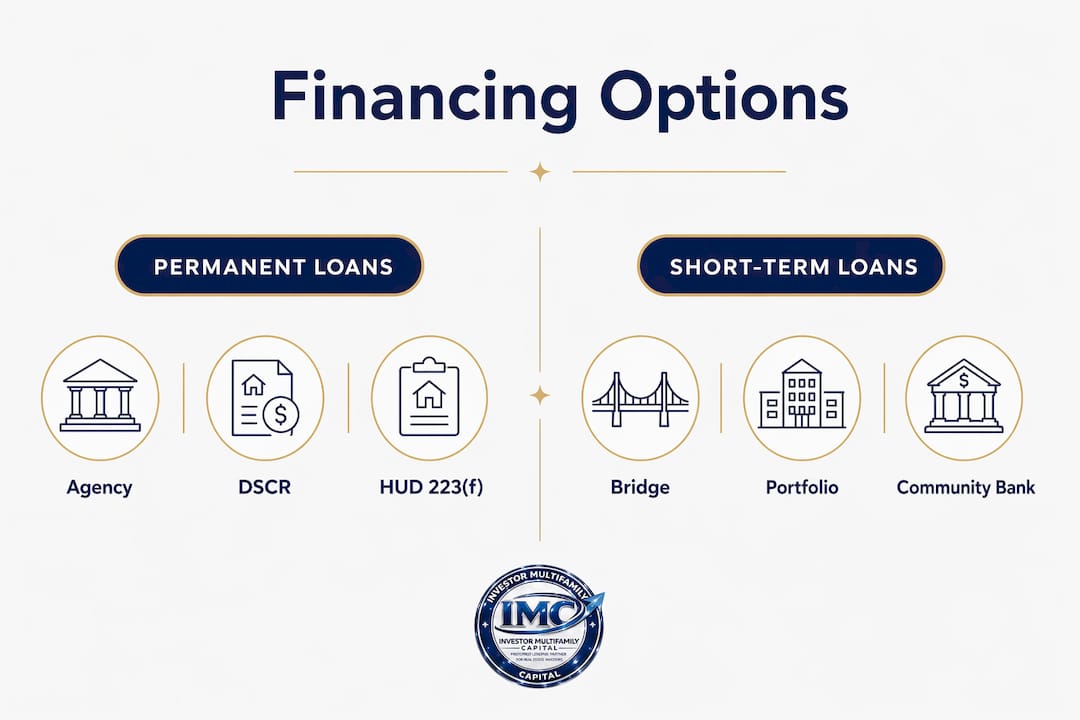
Financing a 5+ unit multifamily property means working with commercial loan products that evaluate the property’s cash flow and stabilization status, not just your personal income. Once a building reaches five units, lenders classify it as commercial real estate. That classification changes everything: underwriting shifts from personal debt-to-income ratios to metrics like Debt Service Coverage Ratio (DSCR) and Loan-to-Value (LTV). The primary loan options include agency loans from Fannie Mae and Freddie Mac, HUD 223(f) programs, DSCR loans, and bridge loans. Choosing the right product determines your debt service costs, cash-on-cash return, and long-term exit flexibility.
What are the main financing options for 5+ unit multifamily properties?
Five or more units means commercial underwriting. That single fact shapes every loan option available to you.

Portfolio and community bank loans
Portfolio lenders, including community banks and credit unions, hold loans on their own books. They offer flexibility on borrower profile and property condition. LTV typically runs 65%–75%, with DSCR minimums around 1.20x. These loans suit smaller stabilized buildings where agency programs may not apply or where speed matters more than rate.
Agency loans: Fannie Mae and Freddie Mac
Agency loans from Fannie Mae and Freddie Mac target stabilized multifamily properties with strong occupancy. Fannie Mae’s delegated underwriting model allows approved lenders to close deals faster than traditional commercial underwriting. That speed advantage is real. Expect high leverage, competitive pricing, and fixed or floating rate options. These programs reward clean stabilization documentation and consistent rent rolls.
HUD 223(f) loans
HUD 223(f) offers FHA-insured permanent financing up to 85% LTV with 35-year fixed amortizing terms for stabilized properties of five or more units. The non-recourse structure protects the borrower’s personal assets. The tradeoff is time. Closing typically takes 4–6 months, and the program carries specific Mortgage Insurance Premium (MIP) fees and occupancy requirements. HUD 223(f) is the right tool for long-term holds where locking in a fixed rate for decades outweighs the slower timeline.
DSCR loans
DSCR loans qualify on property income without W-2s or tax returns. That makes them the preferred choice for investors with complex tax situations or large portfolios. Typical requirements include 20%–30% down, a credit score above 660–680, and a DSCR of 1.20x–1.30x. Rates run higher than agency products, but execution is faster and documentation requirements are lighter. For 5–10 unit buildings, DSCR loans fill a gap that agency programs often leave open.
Bridge loans
Bridge loans provide short-term capital for value-add or lease-up properties that are not yet stabilized. Terms typically run 18 months to 2 years, with possible extensions. Down payments range from 25%–35%, and rates are higher than permanent financing. Bridge loans are a gap tool. They give you capital and time to reposition a property before refinancing into a permanent loan.
Pro Tip: Before selecting a loan type, map your property’s current occupancy and net operating income (NOI). Lenders use these numbers to determine which programs your deal qualifies for from the start.
| Loan Type | LTV | Term | Best For |
|---|---|---|---|
| Portfolio/Community Bank | 65%–75% | 5–20 years | Small stabilized buildings |
| Fannie Mae/Freddie Mac | Up to 80% | 5–30 years | Stabilized, high-occupancy properties |
| HUD 223(f) | Up to 85% | 35 years fixed | Long-term holds, non-recourse |
| DSCR Loan | 70%–80% | 5–30 years | Investors without W-2 income |
| Bridge Loan | 65%–75% | 18 months–2 years | Value-add, lease-up |
How do lenders underwrite 5+ unit multifamily property loans?
Lenders underwrite commercial multifamily loans on property performance, not personal income. Understanding the key metrics lets you model your deal before you approach a lender.
Key underwriting metrics every investor must know:
- DSCR (Debt Service Coverage Ratio): NOI divided by annual debt service. Most lenders require 1.20x–1.30x. A DSCR below 1.0x means the property does not cover its own debt payments.
- LTV (Loan-to-Value): The loan amount as a percentage of appraised value. LTV norms range from 65%–85% depending on loan type and property condition. Higher LTV means less cash down but more risk.
- NOI (Net Operating Income): Gross rental income minus operating expenses, before debt service. This is the single number lenders care about most.
- Debt Yield: NOI divided by the loan amount. Lenders use this as a floor constraint independent of cap rates or appraisals.
- Credit Score: Most programs require 660 or above. Agency and HUD programs may require higher scores with stronger documentation.
- Occupancy/Stabilization: Permanent loans typically require 90%+ occupancy for 90 days or more. Properties below that threshold need bridge financing first.
- Reserves: Lenders require cash reserves, often 6–12 months of debt service, to cover vacancies and capital expenditures.
Lenders evaluate loans based on DSCR, LTV, and debt yield simultaneously. Improving one metric does not increase loan proceeds if another constraint is binding. That is why modeling all three together before submitting a deal matters.
Pro Tip: Build a lender-style DSCR model using conservative vacancy (8%–10%) and realistic expense ratios before you approach any lender. Deals that pencil at 5% vacancy often fail at 8%.
Down payment requirements typically run 20%–30% for DSCR and portfolio loans. HUD 223(f) allows up to 85% LTV, reducing the required equity contribution significantly for qualifying stabilized assets. The right loan structure depends on how much equity you want to deploy and what cash-on-cash return you need to hit.
What steps should you take to secure multifamily financing?
A clear process reduces wasted time and improves your odds of closing at favorable terms.
- Assess property stabilization status. Determine current occupancy, rent rolls, and operating history. Stabilized properties qualify for permanent financing. Properties below 90% occupancy need bridge loans first.
- Build a DSCR model. Use realistic vacancy and expense assumptions. Calculate NOI, DSCR, and debt yield at multiple leverage points. This tells you which loan programs your deal can support.
- Gather borrower documentation. Collect credit reports, entity documents, personal financial statements, and a schedule of real estate owned. Even DSCR loans require basic borrower qualification.
- Shop multiple lender types. Contact portfolio banks, agency lenders, HUD-approved lenders, and DSCR loan providers in parallel. Each channel has different pricing, speed, and flexibility.
- Prepare a deal package. Include the rent roll, trailing 12-month operating statement, property photos, and a brief business plan. A clean package signals a serious operator.
- Submit applications and compare term sheets. Evaluate rate, LTV, prepayment structure, recourse, and closing timeline together. The lowest rate is not always the best deal.
- Plan for timeline differences. Bridge loans can close in 2–4 weeks. Agency loans take 45–90 days. HUD 223(f) requires 4–6 months. Build your timeline around the loan type, not the other way around.
Common pitfalls include submitting to agency lenders before a property is fully stabilized, underestimating closing costs on HUD programs, and ignoring prepayment penalties on fixed-rate loans. Each of these mistakes costs money and time.
What financing strategies maximize cash flow on 5+ unit properties?
The right financing structure directly controls your cash-on-cash return. These strategies reflect how experienced investors approach multifamily investment loans.
- Lock in long-term fixed rates for stabilized holds. HUD 223(f)’s 35-year fixed term eliminates refinancing risk on long-term assets. That predictability has real value in volatile rate environments.
- Use bridge loans to reposition before permanent financing. Bridge financing provides speed and capital while you stabilize a property. Once occupancy hits 90%+, refinancing into an agency or DSCR loan captures lower rates and better terms.
- Balance down payment size against cash-on-cash return. Putting 35% down improves DSCR but reduces your return on equity. Model both scenarios before committing.
- Use Fannie Mae’s delegated underwriting for faster closings. Fannie Mae’s approved lenders compete to close stabilized deals quickly. Speed matters when you are under contract with a hard deadline.
- Match loan type to your business plan. Stabilized properties suit agency or CMBS loans; value-add assets need bridge loans; affordable housing often uses HUD or state programs. Forcing the wrong loan onto a deal creates friction at every stage.
- Understand prepayment penalties before you sign. HUD and agency loans carry yield maintenance or step-down prepayment structures. If your exit plan involves selling within five years, a bridge or DSCR loan with lighter prepayment terms may protect more of your profit.
- Maintain reserves above lender minimums. Lenders require reserves. Experienced operators hold more. A six-month debt service reserve protects cash flow during lease-up gaps and capital expenditure cycles.
Key Takeaways
Financing a 5+ unit multifamily property requires matching the loan type to the property’s stabilization status, cash flow metrics, and your investment timeline.
| Point | Details |
|---|---|
| Commercial classification | Five or more units triggers commercial underwriting based on NOI, DSCR, and LTV. |
| Loan type selection | Match the loan to property condition: bridge for value-add, agency or DSCR for stabilized assets. |
| DSCR minimum | Most lenders require a DSCR of 1.20x–1.30x; model this before approaching any lender. |
| HUD 223(f) advantage | Offers up to 85% LTV and 35-year fixed terms for stabilized properties, with a 4–6 month close. |
| DSCR loan flexibility | Qualifies on property income without W-2s, making it ideal for investors with complex tax profiles. |
What I’ve learned about multifamily financing that most guides skip
Most investors approach 5+ unit financing as if it works like a residential mortgage with a bigger number. It does not. The underwriting logic is fundamentally different, and the mistakes that follow from that misunderstanding are expensive.
The most common error I see is submitting a deal to a permanent lender before the property is truly stabilized. Fannie Mae and Freddie Mac want clean documentation of sustained occupancy, not a property that just hit 90% last month. If you push a near-stabilized asset into agency underwriting too early, you waste time and sometimes lose the deal entirely. A bridge loan for multifamily is not a consolation prize. It is the correct tool for that stage of the business plan.
The second thing most guides ignore is the interaction between DSCR, LTV, and debt yield. Investors often focus on LTV and assume that a lower loan amount automatically improves their terms. But if debt yield is the binding constraint, reducing the loan does not help. You need to model all three metrics together to find the actual ceiling on proceeds.
Finally, prepayment penalties on agency and HUD loans catch investors off guard. A 35-year HUD loan with yield maintenance is not the right structure if you plan to sell in year four. Know your exit before you pick your financing.
— Joe
Investor MultiFamily Capital: multifamily financing built for investors
Investor MultiFamily Capital specializes in business-purpose financing for 5+ unit multifamily properties across New England and Florida. Whether your deal needs a DSCR multifamily loan for a stabilized asset or a bridge loan to reposition a value-add property, Investor MultiFamily Capital structures financing around property cash flow, not personal income.
Investor MultiFamily Capital serves investors in Massachusetts, New Hampshire, Rhode Island, Connecticut, Maine, and Florida. Qualification is based on DSCR and LTV, with no W-2 or tax return requirements for DSCR products. Submit a Deal, Run Deal Analysis, or Apply Online to get your scenario in front of an experienced multifamily lender. Explore multifamily financing options to find the right structure for your next acquisition or refinancing.
FAQ
What makes a 5+ unit property different from a 1–4 unit loan?
Five or more units triggers commercial underwriting. Lenders evaluate the property’s NOI, DSCR, and LTV rather than the borrower’s personal debt-to-income ratio.
What DSCR do I need to finance a multifamily property?
Most lenders require a DSCR of 1.20x–1.30x for 5+ unit properties. A DSCR below 1.0x means the property cannot cover its own debt service and will not qualify for permanent financing.
How long does it take to close a multifamily loan?
Timeline depends on loan type. Bridge loans can close in 2–4 weeks. Agency loans from Fannie Mae or Freddie Mac typically take 45–90 days. HUD 223(f) loans require 4–6 months due to FHA review requirements.
Can I qualify for a multifamily loan without W-2 income?
Yes. DSCR loans qualify on property income alone, with no W-2s or tax returns required. This makes them the preferred option for investors with complex tax situations or large real estate portfolios.
When should I use a bridge loan instead of a permanent loan?
Use a bridge loan when the property is below 90% occupancy or not yet stabilized. Bridge financing gives you capital and time to reposition the asset before refinancing into a permanent agency or DSCR loan.
Investor-only. Business-purpose investment property financing only. Not for owner-occupied or primary residence loans.