TL;DR:
- A structured multifamily portfolio strategy emphasizes goal setting, market selection, financing, and operational discipline. Investors who follow this approach can scale effectively and build lasting wealth through consistent management and diversification. Poor operations, risky financing, and scaling too fast without systems are common pitfalls to avoid.
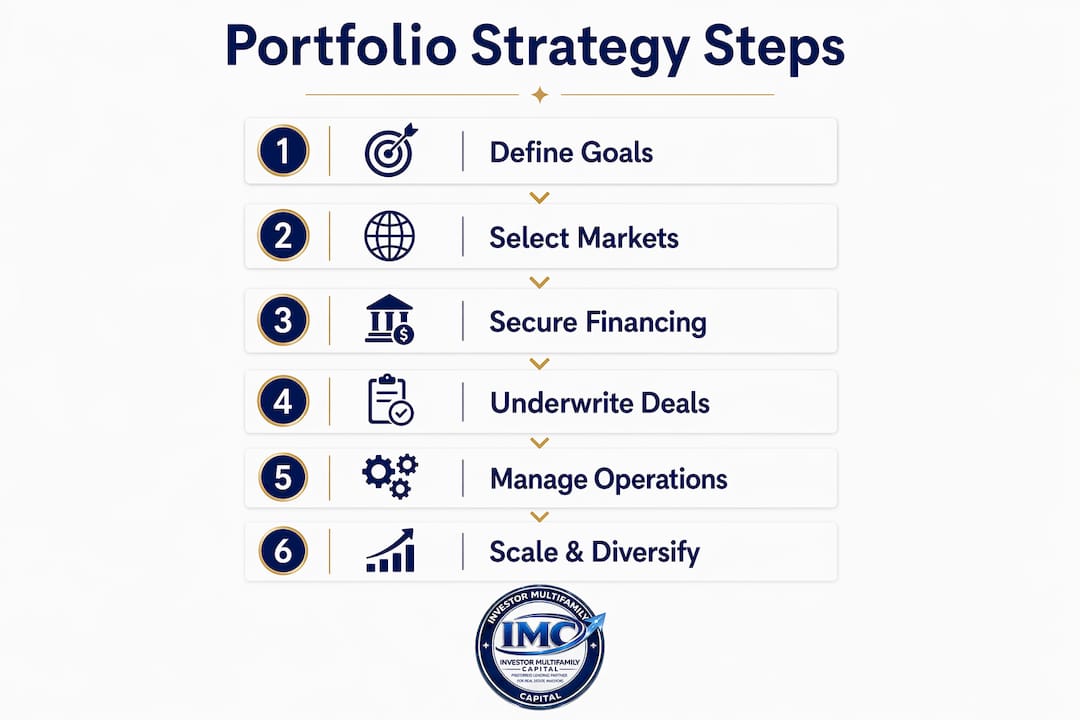
A multifamily portfolio strategy is a structured process of setting investment goals, selecting target markets, securing the right financing, and managing operations to generate consistent cash flow and equity growth. Investors who skip this structure buy properties reactively and stall out at two or three units. The investors who scale to 20, 50, or 100 units follow a repeatable system from day one. This guide covers the full framework: goal setting, market selection, financing structure, operational execution, and disciplined scaling. Whether you’re building a real estate portfolio in Massachusetts, Connecticut, or Florida, the principles apply across every market.
How to build a multifamily portfolio strategy that works
A practical multifamily portfolio strategy starts with one question: what does success look like in five years? The answer determines every decision that follows, from asset class to financing type to hold period. Investors who skip this step end up with mismatched assets that serve no clear financial purpose.
Define your primary investment goal
Three goals drive most multifamily investment strategies: monthly cash flow, long-term appreciation, and equity-building through forced appreciation. Each goal points to a different property type, market, and financing structure. A cash flow investor targets workforce housing in secondary markets with stable employment. An appreciation investor targets supply-constrained coastal markets where rents and values rise faster. An equity-building investor targets value-add assets where renovations can justify $100–$300 rent premiums per unit, then refinances to recycle capital.
Choose markets with strong fundamentals
Market selection is where most investors make their first major mistake. Strong multifamily markets share four characteristics: job growth across multiple employers, household income growth above 4%, constrained for-sale housing supply, and favorable landlord regulations. Structural renter demand is anchored by affordability constraints in for-sale housing, not cyclical trends. That means markets where homeownership is expensive relative to incomes produce durable rental demand regardless of interest rate cycles.

New England markets like southern New Hampshire, coastal Maine, and central Connecticut fit this profile well. They combine stable employment bases, limited new multifamily supply, and strong household formation. Florida markets, particularly in secondary metros, add population growth to that mix.
Pro Tip: Screen markets by rent-to-income ratio before underwriting individual deals. A ratio below 30% signals renters can absorb modest rent increases without high turnover.
What financing structure supports long-term portfolio growth?
Financing is the variable most investors underestimate. The wrong loan structure can force a sale at the worst possible time. The right structure gives you time to execute your business plan regardless of what the market does.
Fixed-rate vs. bridge financing
The choice between fixed-rate permanent debt and bridge financing depends on your asset’s current condition and your renovation timeline. Bridge loans fund acquisitions and renovations before a property qualifies for permanent financing. Once stabilized, investors refinance into long-term fixed-rate debt. Value-add multifamily investing in 2026 relies on this sequence: bridge financing during renovation, then permanent loans once occupancy and rents stabilize.
| Financing Type | Best Use Case | Key Risk |
|---|---|---|
| Bridge loan | Acquisition and renovation period | Rate exposure if stabilization delays |
| DSCR loan | Stabilized cash-flowing assets | Requires minimum debt service coverage |
| Fixed-rate permanent | Long-term hold, portfolio stability | Prepayment penalties on early exit |
| Cash-out refinance | Recycling equity for next acquisition | Increases leverage on existing asset |
Reserves and underwriting discipline
Agency lenders require replacement reserves of $250–$300 per unit per year, held in escrow and released only for approved capital expenditures. This is not optional. Investors who ignore reserves in their pro forma underestimate true operating costs and overstate cash flow. Build reserves into every deal from day one, not as an afterthought.
Long-term portfolio resilience requires 6–12 months of operating reserves alongside 7–10 year fixed agency debt. That combination gives you the runway to survive a rent dip, a vacancy spike, or a valuation correction without a forced sale.
Pro Tip: Underwrite every deal assuming 10% vacancy and a 5% rent reduction from your pro forma. If the deal still works, you have a real margin of safety.
How does operational execution drive multifamily cash flow?
Cash flow is primarily driven by operational excellence, not acquisition price. Management, systems, and tenant relations separate investors who grow from those who stall. This is the insight most new investors miss: you can buy a great deal and still lose money through poor operations.
Build systems for tenant retention and expense control
Tenant turnover is the single largest controllable expense in multifamily operations. Each vacancy costs you lost rent, make-ready expenses, and leasing time. The math compounds fast across a portfolio of 20 or 30 units.
- Start lease renewal outreach 90 days before expiration. Use current market comps to set renewal rents. Offer renewal incentives before the tenant starts shopping alternatives.
- Target renewal rates above 70%. Review payment history and maintenance requests as part of each renewal decision. Residents with clean records get priority renewal offers.
- Standardize vendor contracts. Negotiate annual maintenance contracts for HVAC, plumbing, and landscaping. Volume pricing across multiple properties cuts per-unit costs significantly.
- Transition to professional management at scale. Self-managing two or three units is viable. Self-managing ten or more units without systems is a full-time job that limits your ability to source the next deal.
- Track NOI monthly, not quarterly. Expense variances compound. Catching a $500 overage in month one prevents a $6,000 annual drag on your net operating income.
Pro Tip: Build a management playbook before you need it. Document your lease renewal process, maintenance response standards, and vendor list. That playbook becomes the foundation for scaling without chaos.
What are the best strategies for scaling and diversifying multifamily investments?
Scaling multifamily portfolios requires repeatable deal sourcing, underwriting discipline, and institutional-level operations. Acquiring more units without those systems in place creates compounding risk, not compounding returns.
Build a repeatable acquisition process
Systematic deal sourcing means you are always evaluating opportunities, not scrambling when a deal appears. Build relationships with commercial brokers, property managers, and local lenders in your target markets. Off-market deals come through relationships, not MLS searches.
- Underwrite every deal with the same template. Consistency reveals patterns and prevents emotional decisions.
- Set minimum return thresholds before you look at a deal. If it doesn’t hit your cash-on-cash target at conservative assumptions, pass.
- Track every deal you underwrite, including the ones you pass on. That data tells you what your market actually looks like.
Diversify to reduce concentration risk
Geographic concentration is a real risk. A portfolio of ten properties in one submarket is exposed to a single employer layoff, a zoning change, or a local supply surge. Spreading assets across two or three markets reduces that exposure without adding management complexity if you use professional management in each market.
Tenant base diversification matters too. Workforce housing in multiple income bands reduces the risk that a single economic shock empties your units simultaneously. Recession-resilient portfolios focus on workforce housing because demand holds even when higher-end rentals soften.
| Diversification Lever | Risk Reduced | Practical Approach |
|---|---|---|
| Geographic spread | Local market shock | Target 2–3 distinct metro areas |
| Asset size mix | Financing concentration | Mix small and mid-size multifamily |
| Tenant income bands | Economic cycle exposure | Blend workforce and moderate-income |
| Hold period planning | Forced sale risk | Underwrite for 7–10 year holds |
What are the most common pitfalls in multifamily portfolio building?
Most multifamily investing mistakes are predictable. They cluster around four areas: underwriting errors, financing mismatches, operational neglect, and scaling too fast without systems.
- Skipping replacement reserves in the pro forma. Lenders require them. Deferred capital expenditures destroy cash flow when they hit. Budget $250–$300 per unit per year from day one.
- Using short-term financing on long-term holds. Bridge loans are tools for transitional periods, not permanent capital. Investors who hold bridge debt too long face refinancing risk when rates move or values drop.
- Overestimating rent growth without professional management. Rent premiums from renovations require effective lease-up management. Value-add failures often trace back to a mismatch between renovation timelines and lease-up execution.
- Underestimating turnover costs. Vacancy, make-ready, and leasing fees add up to one to two months of lost rent per unit per turn. High turnover erases the rent growth you worked to achieve.
- Scaling before systems are in place. Adding units to a disorganized operation multiplies the problems, not the profits.
Pro Tip: Build your lender and broker relationships before you need them. Investors who close fast on good deals have pre-existing relationships with capital sources. Cold outreach during a deal timeline rarely works.
Key takeaways
A disciplined build multifamily portfolio strategy requires clear investment goals, conservative underwriting, operational systems, and geographic diversification to generate consistent returns across market cycles.
| Point | Details |
|---|---|
| Define goals first | Set your primary objective (cash flow, appreciation, or equity-building) before selecting any asset. |
| Underwrite conservatively | Model 10% vacancy and a 5% rent reduction to stress-test every deal before committing. |
| Match financing to timeline | Use bridge loans for value-add periods and fixed-rate permanent debt for long-term holds. |
| Prioritize tenant retention | Begin lease renewal outreach 90 days out and target renewal rates above 70% to control turnover costs. |
| Diversify before scaling | Spread assets across multiple markets and tenant income bands before adding significant unit count. |
What I’ve learned about building multifamily portfolios that last
Most investors focus on the acquisition. The deal, the price, the cap rate. That’s where the excitement is. But after watching portfolios succeed and fail across multiple cycles, the pattern is clear: the investors who build lasting wealth are the ones who obsess over operations, not acquisitions.
You can buy a mediocre deal in a good market and make money if you manage it well. You can buy a great deal in a good market and lose money if you manage it poorly. Operations are the real variable. Systems, tenant relations, expense discipline, and management quality determine whether your portfolio compounds or stagnates.
The other thing I’d push back on is the idea that scaling fast is the goal. It isn’t. Scaling with discipline is the goal. Every underwriting error you make on unit 5 gets repeated on units 6 through 50 if you don’t catch it. The investors who build institutional-quality portfolios from smaller starting points do so by treating every deal as if it were the template for the next ten.
The 2026 financing environment rewards patience and preparation. Multifamily demand remains structurally supported by affordability constraints in for-sale housing, which means the rental demand thesis is durable. But financing terms, cap rates, and valuations are moving. Investors who enter deals with conservative underwriting and long fixed-rate debt will have options when others face forced sales.
Build the system first. The units follow.
— Joe
Financing your multifamily portfolio with Investor MultiFamily Capital
Investor MultiFamily Capital works with real estate investors across New England and Florida who are building and growing multifamily portfolios. Financing decisions are based on property cash flow, not personal income, which means you can move fast when the right deal appears.

Investor MultiFamily Capital offers multifamily financing options including fixed-rate permanent loans, bridge loans for value-add acquisitions, DSCR loans for stabilized assets, and cash-out refinancing to recycle equity into your next deal. Investors in Massachusetts, Connecticut, Maine, New Hampshire, Rhode Island, and Florida can apply online or submit a deal for review. The team underwrites based on the asset, not a W-2. Submit a Deal or Run Deal Analysis to get started.
FAQ
What is a multifamily portfolio strategy?
A multifamily portfolio strategy is a structured plan for acquiring, financing, and managing multiple rental properties to achieve specific financial goals such as cash flow, appreciation, or equity growth. It includes market selection, underwriting criteria, financing structure, and operational systems.
How many units do you need to start building a multifamily portfolio?
Most investors start with a small multifamily property of 2–4 units to learn operations before scaling. The key is establishing repeatable underwriting and management systems early, regardless of unit count.
What financing works best for a growing multifamily portfolio?
Bridge loans work best during acquisition and renovation periods. Once a property stabilizes, investors refinance into fixed-rate permanent debt or DSCR loans to lock in long-term cash flow and reduce rate exposure.
How do replacement reserves affect multifamily cash flow?
Agency lenders require replacement reserves of approximately $250–$300 per unit per year, held in escrow. Investors who exclude these from their pro forma overstate cash flow and face budget shortfalls when capital expenditures hit.
What is the biggest risk when scaling a multifamily portfolio?
The biggest risk is scaling without operational systems in place. Underwriting errors and management inefficiencies that are manageable on a small portfolio compound across a larger one, eroding NOI and increasing vacancy.
Investor-only. Business-purpose investment property financing only. Not for owner-occupied or primary residence loans.